El impacto en el oído

http://volumenurbano.blogspot.com/2006/12/el-impacto-en-el-odo.html

Erika Escoda publica la siguiente imagen en el blog del artista sonoro Sergio Avello.

Literal:
El oído interno posee células pilosas denominadas ciliares (arriba), las cuales convierten los estímulos físicos en impulsos cerebrales. La exposición a sonidos fuertes hace que esta suerte de bosque en miniatura quede como si una tormenta lo hubiese devastado (abajo).

Una de las funciones del vúmetro “Volumen”, es advertirnos sobre los estándares de tolerancia de nuestra sensibilidad y nuestra salud.

Esta información proviene de
http://news.bbc.co.uk/hi/spanish/science/newsid_5324000/5324434.stm
http://volumenurbano.googlepages.com/c%C3%A9lulasauditivas

oidocelulas.jpg

LEV Festival, Gijón

Laboratorio de Electrónica Musical
http://www.levfestival.com/

23 y 24 de marzo
Gijón

lev_festival.gif

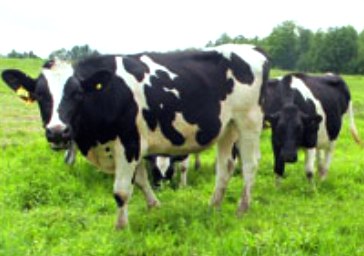
Cows also ‘have regional accents’

Cows also ‘have regional accents’

Cows have regional accents like humans, language specialists have suggested.

They decided to examine the issue after dairy farmers noticed their cows had slightly different moos, depending on which herd they came from.

John Wells, Professor of Phonetics at the University of London, said regional twangs had been seen before in birds.

The farmers in Somerset who noticed the phenomenon said it may have been the result of the close bond between them and their animals.

Farmer Lloyd Green, from Glastonbury, said: “I spend a lot of time with my ones and they definitely moo with a Somerset drawl.

“I’ve spoken to the other farmers in the West Country group and they have noticed a similar development in their own herds.

“It works the same as with dogs - the closer a farmer’s bond is with his animals, the easier it is for them to pick up his accent.”

I spend a lot of time with my ones and they definitely moo with a Somerset drawl. Lloyd Green - Farmer

cow_203b.jpg

Microphone Bruel and Kjær model 4939

Microphone Bruel and Kjær model 4939

Free-field ¼-inch Microphone — Type 4939
The Free-field ¼Microphone is specially designed for high level and high frequency measurements.
By using stainless steel diaphragm and protection grid, the microphone is optimised to withstand rough environments and is capable of working at high temperatures – up to 150 C (302 F).

USES
m High level measurements
m High frequency measurements
m Model work

FEATURES
m Sensitivity: 4 mV/Pa
m Frequency: 4 – 100,000 Hz

microphone-4939.JPG

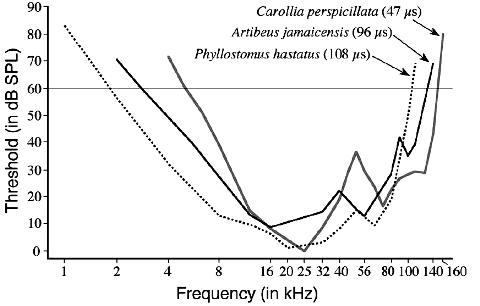
Hearing in American leaf-nosed bats. Artibeus jamaicensis

Hearing in American leaf-nosed bats. III: Artibeus jamaicensis

Rickye S. He!ner _, Gimseong Koay, Henry E. He!ner
Department of Psychology, University of Toledo, Toledo, OH 43606, USA
Received 10 March 2003; accepted 23 July 2003

Abstract
We determined the audiogram of the Jamaican fruit-eating bat (Phyllostomidae: Artibeus jamaicensis), a relatively large (40^50 g) species that, like other phyllostomids, uses low-intensity echolocation calls. A conditioned suppression/avoidance procedure with a fruit juice reward was used for testing. At 60 dB SPL the hearing range of A. jamaicensis extends from 2.8 to 131 kHz, with an average best sensitivity of 8.5 dB SPL at 16 kHz. Although their echolocation calls are low-intensity, the absolute sensitivity of A. jamaicensis and other ‘whispering’ bats does not differ from that of other mammals, including other bats. The high-frequency hearing of A. jamaicensis and other Microchiroptera is slightly higher than expected on the basis of selective pressure for passive sound localization. Analysis suggests that the evolution of echolocation may have been accompanied by the extension of their high-frequency hearing by an average of one-half octave. With respect to low-frequency hearing, all bats tested so far belong to the group of mammals with poor low-frequency hearing, i.e., those unable to hear below 500 Hz.

Key words: Audiogram; Chiroptera; Echolocation; Evolution; Mammal

bat.JPG

Ophonine Pophorn software

www.unsworn.org/pophorn

“An upcoming series of applications that transform your cellphone into various musical instruments. With the Ophonine you can record and play sound loops with a simple press of a button […] The mobile is not just a phone – it’s a powerful and very portable multimedia computer. By downloading a piece of software to your phone everyone could be walking around with a set of musical instruments in their pocket!” says Unsworn representative Erik Sandelin. ”Unsworn don’t see people as passive consumers but as active creators or protagonists who put a lot of effort into making personal technologies truly personal. The future of mobile audio is not just about downloading ringtones – but in creating your own music, actively remixing the world you live in. The Ophonine Pophorn is based on Unsworn’s interactive sound art installation, the Four Ophones, which has been touring the world the last years: from galleries in Tokyo and Paris to Central Park in New York and the Ars Electronica festival in Austria […] The Ophonine Pophorn software run on most new mobile phones and will be available for free download from www.unsworn.org/pophorn in May 2007 […]”

Via: Nerworked Performance

unsworn.jpg

PLAY: festival de cine en directo

Play es un festival de cine en directo centrado en seis conciertos audiovisuales que tendrán lugar en el Patio de La Casa Encendida. Los conciertos, dos cada noche, ofrecen la posibilidad de conocer las propuestas más innovadoras de la escena internacional y ponen especial énfasis en la idea de la imagen como instrumento musical. Play presenta un amplio panorama de actuaciones en donde la interacción entre imagen y sonido está siempre en juego.

Las distintas relaciones que se pueden establecer entre los dos medios vertebran la programación del festival. Ryochi Kurokawa y Skoltz_Kolgen trabajan la imagen gráfi ca y el sonido como una sola cosa, son músicos a la vez que artistas visuales. Christian Marclay, en cambio, estrena un vídeo mudo cuyas imágenes sirven como partitura para la interpretación en directo de tres tríos musicales. El percusionista japonés DoraVideo convierte su batería en una mesa de mezclas desde la que genera torrenciales secuencias de imágenes fragmentadas. En la propuesta de reacTable se introduce un instrumento nuevo diseñado por ellos mismos, una mesa luminosa que combina lo táctil con lo visual y lo auditivo de una manera ejemplar. Por último, el grupo Metamkine pone especial énfasis en la interacción entre la música en directo y la proyección simultánea de películas de 16mm sobre espejos en una trabajada síntesis de medios.

A pesar de la variedad de los procedimientos, todos los artistas se acercan a la compleja encrucijada del sonido y la imagen, con la intención de actuar sobre los dos medios en el instante, de trasladar algo de la espontaneidad de la creación musical al mundo de la imagen, y de combinar lo visual y lo sonoro de una manera intuitiva y fluída.

>> Del 02.03.2007 al 04.03.2007 en la casa encendida (madrid)

metamkine.jpg

Automates Ki

Automates Ki

a sound installation and performance, by Maxime De La Rochefoucauld

This installation is about music performed by automatons: mechanized acoustic sculptures animated by inaudible frequencies. Their oddly organic polyrhythms are orchestrated to produce a ritualistic trance-like music.
The automatons are activated by high and low inaudible frequencies. Those frequencies drive the membranes of little woofers* on which a structure made out of sticks and springs is attached. The structure hits acoustic instruments like drums, cymbals, strings, bells, cans, etc.
All the automatons are controlled individually by an impulsion board. This impulsion board is like a traditional mixing board. But instead of an audio volume, it is the electrical power of the impulsion given to the automatons which itself generates an acoustic sound. This impulsion board has 24 faders which receive different impulsions and 24 outputs connected to an amplification tower.
*Some of the automatons are activated by soleno•ds.

“…When the trumpet gets going, the sound is almost on par with electric Miles Davis; the whole manner in which this beast is assembled brings to mind zany sculptor Jean Tinguely…” Mike McGonigal, Raygun

“… The ethnic polyrhythms flow in and out of a linear structure, laying the groundwork for shadowy, inscrutable soundscapes. Drones and washes swim through the ether behind the drums, occasionally pierced by metallic crashes or atonal howls and flares. Seductive, hypnotic and frequently frightening. A resounding success.” Rupert Bottenberg, Mirror

for more information:

maxime.jpg

SYNCHRONATOR

http://www.umatic.nl/synchrosite/

Literal:
SYNCHRONATOR is a video and audio research project by Gert-Jan Prins and Bas van Koolwijk in an attempt to use a combination of current digital and analogue means in order to make more use of the characteristic visual qualities of such techniques.
[more…]

Via: neural.it

synchro_06.jpg

medialabmadrid openlab viernes

Viernes OpenLab

Fechas: 9, 16 y 23 de marzo; 13, 20 y 27 de abril
Horario: de 17:30 a 20:30
Fecha límite para inscribirse: 6 de marzo

http://www.medialabmadrid.es/viernesOpenlab.html

Los viernes por la tarde mlm ofrece un espacio de encuentro y formación abierto a todas aquellas personas que están desarrollando propuestas, prototipos o experimentos de arte digital y sonoro, diseño crítico, aplicaciones educativas u otros proyectos que utilizan tecnologías digitales. En estos “minitalleres”, los participantes podrán poner sus proyectos en común con otra gente, conocer soluciones a problemas técnicos puntuales, reorientar su desarrollo en colaboración con otras personas o conocer algunas herramientas que les puedan ser de utilidad.

La actividad se estructurará en diferentes módulos temáticos:

· Arduino / objetos interactivos / computación física

Coordinadores/tutores: Ángela Ramos e Igor González

· Computer vision e instalaciones interactivas audiovisuales

Coordinadores/tutores: Martín Nadal y Julio Obelleiro

· mobile.Processing

Coordinador/tutor: Abelardo Gil-Fournier

· Del potenciómetro a la computer music: creación de instrumentos sonoros

Coordinador/tutor: Enrique Tomás

· Creación visual en tiempo real

Coordinadores/tutores: Iván Gómez España, Itziar Arriaga y Óscar Testón

314132559_e27e1c6836.jpg

V Encuentro Internacional de Performance

info

Lugar: IVAM
2 y 3 de marzo 2007
Entrada libre
20 h

Viernes, 2 de marzo

JULIEN BLAINE L’eau racle (une déclaraction)
PAUL PANHUYSEN Multiplier Music

Sábado, 3 de marzo

CONCHA JEREZ y JOSÉ IGES No hables con la boca llena
JAMIE MCMURRY Golden delicious

padin34c1.jpg

Scanned Synth VST

http://humanoidsounds.co.uk/

Scanned Synth VST is the first VST plug-in to implement “Scanned Synthesis” - until now, this new synthesis technology has only been available to users of Csound and Max. Scanned Synth VST is a revolutionary musical instrument as well as a tool for creating sounds that have never been heard before. Many have described using it as a totally refreshing experience, inspiring whole new pieces of music or avenues of experimentation. What’s more… It’s totally free!

Scanned Synth VST is only available for Microsoft Windows-based PCs.

Scanned Synthesis represents a powerful and efficient technique for animating wavetables and controlling them in real-time. Developed by Bill Verplank, Rob Shaw, and Max Mathews between 1998 and 1999 at Interval Research, Inc. it is based on the psychoacoustics of how we hear and appreciate timbres and on our motor control (haptic) abilities to manipulate timbres during live performance.

Scanned Synthesis involves a slow dynamic system whose frequencies of vibration are below about 15 Hz. The ear cannot hear the low frequencies of the dynamic system. So, to make audible frequencies, the “shape” of the dynamic system, along a closed path, is scanned periodically. The “shape” is converted to a sound wave whose pitch is determined by the speed of the scanning function. Pitch control is completely separate from the dynamic system control. Thus timbre and pitch are independent. This system can be looked upon as a dynamic wave table. The model can be compared to a slowly vibrating string, or a two dimensional surface obeying the wave equation.

Vía: kvraudio

scannedsynthvst.jpg

homenaje a Gyorgy Ligeti

George Benjamin conductor
Pierre-Laurent Aimard piano
Claire Booth soprano

Classic works by one of the 20th century’s musical pioneers, Gyorgy Ligeti, are filled with unexpected sounds and effects. Alexander Goehr’s Behold the Sun conjures up an inspired vision of the Divinity through the eyes of a 16th-century boy. Requiem for Sue is an elegantly crafted trilingual song cycle by Oliver Knussen, reflecting on the nature of loss.

Queen Elizabeth Hall at 6pm: Pre-concert workshop on the sound-world of Gyorgy Ligeti led by composer Rachel Leach and two London Sinfonietta players.

mediateletipos_sound_london sinfonietta

Festival Digressions

Desde hoy, lunes 26, hasta el próximo 11 de marzo, tendrá lugar en Barcelona el festival Disgressions, con las actuaciones de Zeitkratzer, Taylor Deupree + Kenneth Kirschner, Rhys Chataham y Diamanda Galás.

http://digressions.es/

Los objetivos principales del ciclo son, por un lado, familiarizar al público de la música contemporánea con la vanguardia digital y la llamada avant.rock y a los seguidores de estos con nuevos formatos de difusión de un código hasta ahor limitado a una coyuntura estrictamente underground. Por otro lado, situar la ciudad de Barcelona en el centro del mapa exprimental y proponer al tejido creativo local colaboraciones transnacionales con la ambición de propiciar la creación de una red capaz de trascender fronteras.

El festival Digressions tiene previsto concentrar los cuatro conciertos en las diferentes salas del Auditorio de Barcelona, ubicando cada uno de ellos en el espacio que, tanto por las características técnicas como por la cantidad de artistas se adecúe más a sus necesidades.

digressionsfest.jpg

DEAF – Dutch Electronic Art Festival

The Dutch Electronic Art Festival (DEAF) is an international and interdisciplinary biennial that focuses on art, technology and society and is organized by V2_, Institute for the Unstable Media , in Rotterdam.
DEAF presents a wide range of programme segments, including, of course, a large exhibition of interactive artworks and installations. There will also be concerts, performances, seminars, workshops and an academic symposium. The festival is characterized by a thematic approach. Its aim is to bring current developments and themes around art in our technological culture to a diverse audience.
DEAF is one of the most important international festivals focusing on art and media technology, and it can be regarded as a showcase for research for and production of new media art (some specially commissioned).
This festival in Rotterdam is the ideal place for representatives of various networks to meet and inspire each other, and for international critical debate to take place.

mediateletipos_sound_deaf festival