att_kit-kat vacaciones…

TELETIPO INTERNO Es el turno de Chiu Longina y Pablo Sanz Almoguera: se van de vacaciones… La casa queda atendida por Jaun Gil y Pedro Jiménez, que han vuelto de Kekelixi cargados de buenas vibraciones (audio-visuales). Quedais con ellos este mes de septiembre. el mes que viene estrenamos web en mediateletipos.net!! que ustedes lo pasen bien…

pablosanz.jpg
Pablo sanz
 
chiu_holidays.jpgChiu Longina

Singing Bridges

http://www.singingbridges.net/

Singing Bridges

ABOUT
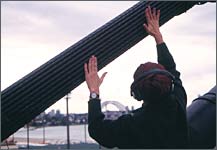
“Singing bridges” is a sonic sculpture, playing the cables of stay-cabled and suspension bridges as musical instruments. To create this work I will amplify and record the sound of bridge cables around the world. Listening in to the secret voice of bridges as the inaudible vibrations in the cables are translated into sound.
An urban sound-scape that reflects the physical and metaphoric structure of the telecommunications network, with its fibre-optic cables circling the globe. The iconography of the bridge cables echoes the telecommunications lines stretching across the globe and linking us together. The work plays on an acoustic extension and interpretation of the constant flow of information and data through these cables.

In the ultimate realisation of this idea, bridges at locations around the world are linked and played in real-time to create an International Bridge Symphony. As the Bridges are connected through the sound of their cables, they create an Acoustic Indra’s Net.

The cables of the bridge also reflect the vaulting in a church, designed to lift the spirit of the congregation to heaven with the vibrations of the choir’s singing. A metaphor for spiritual communication, the bridge cables arching skyward have the potential to lift the commuter to a higher plane.

The project offers a re-interpretation of the familiar architecture of concrete and steel into an experience of metaphysical connection. Allowing for the possibility of a transformative experience of the bridge, other than the everyday pragmatic, economic and visual encounters with architecture.

The sound of singing bridges all around the globe may also strike the resonant frequency of the earth’s materials and dissolve the world. Echoing the Tacoma Narrows Bridge, which was freed from material constraints when the resonant frequency was struck by the wind. Sounding the harmonic frequency within the unheard vibrations of the cables will release the voice and liberate the spirit of each bridge.

Via

singing_bridges.jpg

UBU Web news

http://www.ubu.com/

UBU web news

LITERAL:
Dear Friends,

UbuWeb is offline for the summer to clean house. Please bear with us as we move our media files to WFMU, who have so generously offered much needed server space and bandwidth.

Please note that during this summer, most of our media files (MP3s and films) are offline.

We’ll be back in the fall at this URL (ubu.com) all fresh and shiny.

Have a great summer.

Sincerely,
The Editors

UPDATE:
August 16. We are in the process of transferring our media files to WFMU. If all goes well, we should be up and running by the beginning of September. We’ll keep you posted of our progress here.

Sincerely,
The Editors

ubuweb.jpg

repercussion.org

http://www.repercussion.org

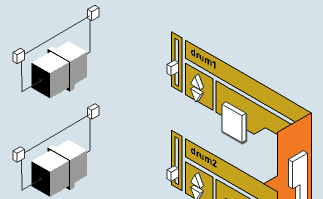
Repercussion.org is a collection of on-screen virtual instruments designed for live performance and online user exploration. Rhythms and musical phrases can be dynamically composed and altered based on the arrangement of objects on the screen.

The collection is a showcase for the visual representation of freely-formed musical compositions. The project aims to be engaging enough to encourage the viewer to experiment, while being sophisticated enough to allow for a great deal of variation in the sound being created. The actual musical compositions are generated in real-time from a library of pre-recorded midi-based sounds, employing algorithms to map the on-screen graphics to characteristics of the sound arrangement such as pitch, tempo and volume. The graphics were designed with a wide audience in mind, such that the concepts represented are accessible to a viewer regardless of his level of musical training, while at the same time matching the artist’s idea of a basic kit of musical instruments for “jamming”: some drums, some melodies, a way to create chords, strings, etc.. To be available to the largest online audience, Macromedia Flash was chosen as the medium.

The piece is a work in progress that will be updated and customized.

280_repercussion.jpg

dozercast

http://www.dozercast.com/

Dozercast

40 minutes of the finest electronic music, IDM, old videogame soundtracks, bizarre exotic oddities and anything elese deemed interesting.

Updated weekly

[RSS podcast]

[Tracklisting]

279_dozercast.gif

sonhors e-zine

http://sonhors.free.fr/

sonhors |e-zine|

naissance et évolution des musiques électroniques ou électroacoustiques au travers des innovations technologiques
de l’instrumentarium et des nouvelles approches du sonore

278_sonhors_ezine.jpg

Babelcast

http://www.flexatone.net/consumable.html#babel

babelcast
information abduction and reduction

Sounds of U.S. and World leaders and commentators fragmented and distorted into something more sensible and digestible. Generated with athenaCL, babelcast is an experimental, algorithmic, computer-generated podcast. Juxtaposed and mixed with dynamic noise textures, the resulting ambient soundscape offers a unique musical perspective on mass media, language, and current events. New editions, built from sounds harvested within a period of days or weeks, will be provided on a regular basis.

[RSS Subcription Feed]

277_babelcast.gif

ICMC 2005. Opening Concerts

http://www.icmc2005.org/index.php?selectedPage=134

ICMC 2005. Opening Concerts

Sunday, September 4th at 20.30 in SGAE
“TeleSon: Invention#8″ by Chris Brown

This piece is composed for four musicians playing two networked “reacTables”, one each in Barcelona and in Linz, Austria. The reacTable is a new electronic music instrument developed at the Music Technology Group in Barcelona by a research team headed by Sergi Jorda. Brown explains: ‘I have interfaced my own synthesis engine, written in SuperCollider3, to the reacTable’s visual and gestural interface, thus composing my own synthesis environment with its own rhythmic and tonal character. Like the other works in my “Inventions” series (recorded on Pogus CD “Talking Drum”), this piece involves polyrhythms, computer networks, and improvisation. Like “Invention #5″ (1999), it also involves musicians collaborating at great physical distance from each other’.

Biographic Notes:
Chris Brown, composer, pianist, and electronic musician, creates music for acoustic instruments with interactive electronics, for computer networks, and for improvising ensembles. Recent recordings of his music are available on Tzadik, “ROGUE WAVE” (2005) and “LAVA” (1992); and on Pogus, “TALKING DRUM” (2001). He has also performed and recorded extensively with “The Hub”, “Room”, and the “Glenn Spearman Double Trio”. As a pianist he has recorded music by Henry Cowell, Luc Ferrari, and John Coltrane; as an electronic musician, he has collaborated with John Zorn and Wadada Leo Smith. He teaches electronic music at Mills College in Oakland, where he is Co-Director of the Center for Contemporary Music (CCM).

“On Nothing” by José Manuel Berenguer
Electroacoustic music for 5 +1 and 3D projections, generated and controlled in real time by means of a game pad. Generation of sound and images has been programmed in Max/MSP-Jitter.
Emptiness and fullness have never been reached by humans. Sometimes we feel they could be the same thing and we build metaphors that relate them. As On nothing, that is a dream where sound is completely empty, a variation of pressure that is only considered in terms of its form, its limit; hence, in terms of something that can not be considered as sound anymore. Its empty sounds are built of a vastness of grains coming from the regular soundscape : traffic, music, wind, demonstrations and other social activities. This basic matter only emerges sometimes from the mainstream of sounds to be recognized. When they do so, they become images from memory and, specially, from oblivion, that strongly evokes emptiness. How a so big amount of experiences could have disappeared forever? When finally nobody could remember them, probably they will fall into void and, perhaps, into absolute worthlessness.

Biographic Notes:
José Manuel Berenguer is Codirector of the Caos/Sonoscop-Experimental Sound Art Archive at the Contemporary Culture Center of Barcelona. He teaches Aesthetics of Electronic Music at ESDI, Ramon Llull University (URL) and Sonic Languages at the on line net university, Universitat Oberta de Catalunya (UOC). Inter-media artist, founder of Côclea, with Clara Gari, and Orquestra del Caos, ex-chairman of the Electroacoustic Music Association of Spain, he is now Chairman of the International Conference of Electroacoustic Music of CIM/UNESCO. He also belongs to the International Academy of Electroacoustic Music/Bourges. In the last years, his work has been oriented to multimedia installation and, despite of the innacuracy of these concepts, to real time and interactivity. His artistic works develop diverse aspects on Filosofy, History of Science, Life and Artificial Inteligence, Robotics and metabolism of information. Recently, he has been working in two projects related to the Metronom’s Science and Art Project: “Lambda-Itter” (2004) with flutist Jane Rigler, an audio visual interactive performance devoted to the ideas of flux and turbulence, and “Mega kai Mikron” (2004), a sonic and visual installation that involves microelectronics tools and based on the the very limits of human comprehension and perception of the world.

icmc2005_concerts.gif

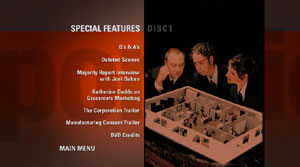
The Corporation film

http://www.thecorporation.com/index.php?page_id=2

The Corporation film

SYNOPSIS
THE CORPORATION explores the nature and spectacular rise of the dominant institution of our time. Footage from pop culture, advertising, TV news, and corporate propaganda, illuminates the corporation’s grip on our lives. Taking its legal status as a “person” to its logical conclusion, the film puts the corporation on the psychiatrist’s couch to ask “What kind of person is it?” Provoking, witty, sweepingly informative, The Corporation includes forty interviews with corporate insiders and critics - including Milton Friedman, Noam Chomsky, Naomi Klein, and Michael Moore - plus true confessions, case studies and strategies for change.

Winner of 24 INTERNATIONAL AWARDS, 10 of them AUDIENCE CHOICE AWARDS including the AUDIENCE AWARD for DOCUMENTARY in WORLD CINEMA at the 2004 SUNDANCE FILM FESTIVAL. The long-awaited DVD, available now in Australia and coming in March to North America, contains over 8 hour of additional footage.

The film is based on the book The Corporation: The Pathological Pursuit of Profit and Power by Joel Bakan.

links:
interview Noam chomsky in Znet (english)
entrevista noam chomsky en Znet (spanish)

the_corporation.jpg

Roland TB-303: The Movie

http://www.nkhstudio.com/pages/popup_bassline.html

Roland TB-303: The Movie

Bassline Baseline, 2005
single channel DVD with sound
dimensions variable
total run time 21 minutes

[VIDEO]

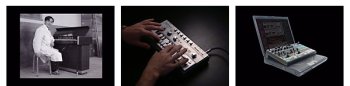
Bassline Baseline is a video essay that investigates the invention, failure and subsequent resurrection of the mythic Roland TB-303 Bass Line music machine in the last two decades of the 20th century. The narrative seeks to invite thoughts on technological mediation within product innovation and creative expression. The dead-panned ‘documentary’ video attempts to explore how and why creative tools fail and how increasingly more options, parameters or intermediaries devised during a tool’s research and development phase don’t necessarily lead to increased expressivity or virtuosity during the tool’s lifetime of actual use, unless the super-structure of its cultural context is dramtically reconsidered.

via: create_digital_music

popup_bassline_thumbs.jpg

Jin Hi Kim : : : Komungo

http://www.jinhikim.com

Jin Hi Kim is highly acclaimed as both an innovative komungo (Korean fourth century fretted board zither) virtuoso and for her cross-cultural compositions. Kim has introduced the Korean indigenous komungo for the first time into Western contemporary music scene with her wide array of pioneering compositions for chamber ensemble, orchestra, avant-garde jazz improvisations and multicultural ensembles. She has co-designed the world’s only electric komungo.

Kim has created the live interactive pieces for electric komungo and MIDI computer system. Using MAX/MSP, the komungo sound is processed through a personal computer program in live that is triggered by MIDI foot pedal. Staying true to the nature of the instrument, her solo interweaves from old timeless mind to space-age blips.

Over twenty years Kim has developed a series of compositions, Living Tones –The timbral persona of each tone generated is treated with an abiding respect, as its philosophical mandate from Buddhism, a reverence for the ‘life’ of a tone, the color and nuance granted each articulation from Korean Shamanism.

[VIDEO]

electric_260x437.jpg

Zehar 56: Mal de Archivo

Zehar 56

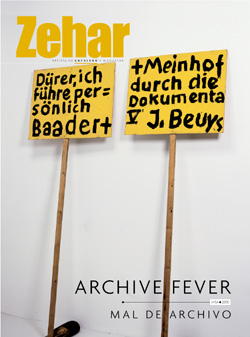
Zehar 56. Mal de archivo

El título del dossier Mal de archivo lo hemos tomado del libro de Jacques Derrida Mal de archivo: una impresión freudiana. Son muchas las lecturas y relecturas que se han hecho de este conocido texto, pero desde Zehar lo hemos querido utilizar para aglutinar en torno a él la problemática del archivo, la idea de lo “otro”, y la de la construcción del por-venir. ¿Quién detenta la autoridad? ¿A quien corresponde la interpretación? ¿Quién recupera la memoria? ¿Funciona el archivo como fetiche? Éstas son algunas de las preguntas que se cuestionan en el monográfico, con el convencimiento, y una vez más siguiendo a Derrida, de que “La democratización efectiva se mide siempre por este criterio esencial: la participación y el acceso al archivo, a su constitución y a su interpretación”.

Xabier Erkizia pone de manifiesto en su artículo la importancia del contexto en la creación y presenta un nuevo proyecto cuyos integrantes provienen de entornos muy diferentes. Azucena Vieites expone en su texto su posición frente al arte y la creación. Jorge Blasco presenta el proyecto Culturas de archivo. Miren Jaio reflexiona sobre la importancia del archivo y para ello toma como base dos exposiciones, Beste Bat! que tuvo lugar en la Sala Rekalde de Bilbao y la muestra sobre la Red Army Faction realizada en la KW de Berlín. Alessandro Ludovico analiza en su artículo la relación entre la edición analógica y la digital y muestra su visión de la situación actual. Leire Vergara realiza en su texto un análisis sobre la muestra Entusiasmo y trata la cuestion de los derechos de autor.

La sección forum es un espacio dedicado temporalmente a la difusión de los debates que están surgiendo alrededor de la producción cultural y los derechos de autor, sus opciones legales y sus alternativas de distribución. En este número presentamos dos textos que tratan sobre la situación actual de las bibliotecas, el primero de Marieke Van Schinjdel y Joost Smiers y el segundo de Ramón Salaberria.

En el apartado de reseñas hemos reunido la crítica que Cecilia Andersson ha realizado sobre la exposición que tuvo lugar en la Barbican Gallery de Londres sobre la obra de Christian Marclay, las reflexiones de Iñaki Urdanibia en torno a L´Abécédaire de Gilles Deleuze, las impresiones de Ana Arregi sobre el libro Travesías por la incertidumbre de Estrella de Diego y las de José Luis Padrón tras haber leído el trabajo Begiradak. Miradas y memorias desde el margen. En la edición inglesa de Zehar hemos recogido la opinión de Cecilia Andersson sobre la última Bienal de Venecia.

zehar56.jpg

Binauralia: blog sonoro

http://binauralia.typepad.com/

Binauralia: blog sonoro

Luis Costa es el editor de este nuevo blog sonoro. Desde el páis vecino, Binauralia es un nuevo blog (aunque el término blog ya se queda corto para definir este tipo de proyectos). Desde mediateletipos seguiremos de cerca sus publicaciones.
Bienvenido.

binauralia_lg.gif

Luc Ferrari R.I.P

http://www.disquiet.com/downstream-past4.html#d20050825-lucf

Luc Ferrari ::: memorial stream

LITERAL:
Reports have circulated that composer Luc Ferrari passed away on August 22. And although at this late hour, some three days later, news.google.com still appears to call up no such search result, the sad news is confirmed at the website of the French newspaper Le Monde (link). Much will be made of Ferrari having died in such close proximity to Robert Moog, creator of his namesake synthesizer systems. Those waiting for a third shoe, or electronic musician, to drop may take comfort in how little Ferrari, born in Paris in 1929, and Moog, born in New York City five years later, had in common. In fact, the nature of their distinct pursuits posits them as twin poles in the course of contemporary music, electronic or otherwise.

Though both used technology to push the creative envelope, Moog did so by creating new instruments that built sounds from the most basic materials, such as sine waves and electronic pulses, while Ferrari came to be associated with musique concrete, with taking recordings (often seemingly a-musical ones, of natural settings) and shaping them, after the fact, into compositions.

Several Ferrari works were presented at the Other Minds festival in 1999, among them his “Presque Rien No. 4,” available in full at the Internet Archive, at archive.org, albeit only in streaming form (link). The piece mixes treated and found sounds in with a recording of Ferrari and his wife, Brunhild Meyer-Ferrari, taking a walk in Italy, where he would later pass away.

STREAM [Luc Ferrari: Presque Rien No. 4 (1998) performed at Other Minds 5, 1999]

ferrari.jpg

IO : The Improbable Orchestra

http://improbableorchestra.com

The Improbable Orchestra (IO) is an interactive audio installation designed to make digital music accessable to anyone.

This sound installation was designed by our team to accomplish the following goals:

1. to create a tool to allow any user to experiment with working and designing music

2. to create a visually appealing structure that creates a musical space

3. to create a musical tool that allows interaction between different players while they experiment with music

The Improbable Orchestra is a music-making tool consisting of a central control unit surrounded by four speakers designed for up to four users to each control a sound sample using manual controls (knobs and buttons).

[VIDEO]

Via : networked_performance

side_double_shot_P_Mendez.jpg