Casas Vieja se queda!! No al desalojo!!

Crónica del colectivo ZEMOS98 del día 29 de noviembre de 2007 en el que se procede al desalojo del Centro Social Okupado y Autogestionadio Casas Viejas (Sevilla). Nuestro apoyo a las personas que están ejerciendo su derecho a la desobediencia civil y seguimos atentos en los canales habituales a lo que pueda ir pasando. Apoya las concentraciones, difunde la información, sal a la calle que es de todos. Más info y coordinación en http://estrecho.indymedia.org

Entre las 7 y las 8 de la mañana ha comenzado el desalojo del CSOA Casas Viejas. Desde ese momento hasta ahora han sido varias las acciones de resistencia que se han venido desarrollando en Sevilla. Ha habido tiempo, desde el 5 de octubre de 2007, para organizar una resistencia pacífica y ejemplar. Se ha conseguido visibilidad mediática y los medios están siendo bastante cautos con criticar las acciones, en todo momento, no-violentas al igual que contundentes.


Seguir Leyendo…

IV ciclo de MÚSICA CONTEMPORÁNEA / cimtec Sevilla transit

IV ciclo de MÚSICA CONTEMPORÁNEA / cimtec Sevilla transit
Sevilla, 10 ~ 15 de diciembre de 2007

CONFERENCIAS
Andrés Lewin-Richter, Juan Antonio Lleó, Leopoldo Amigo, José Manuel Berenguer, María de Alvear, Eva Lainsa, Mikel Arce, Carmen Pardo, Mª Eugenia Luc.

VÍDEO-ARTE
Viva Festival, presentado por Ana de Alvear

INSTALACIÓN INTERACTIVA
¡Elígeme!, de Sculptor Zeta Cluster

CONCIERTOS
Llorenç Barber, Eduardo Polonio, Plural Ensemble, José Manuel Berenguer, Xelo Giner/Andrés Lewin-Richter, Julián Elvira/Gregorio Jiménez

TODA LA INFORMACIÓN: http://www.congreso-musica.org

cimtec.png

Earth Moves, audio-video installation

http://www.semiconductorfilms.com/root/earthmoves/earthmoves.htm

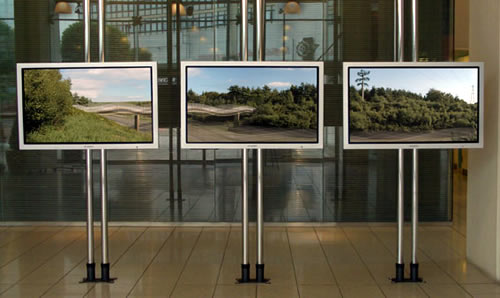
Earth Moves is a continuation of Semiconductors exploration into how unseen forces affect the fabric of our world. The limits of human perception are exposed, revealing a world which is unstable and in a constant state of animation as the forces of acoustic waves come into play on our surroundings.
The south-east of England is explored through a series of five audio controlled photographic panoramas. Semiconductor collected sound recordings and photographs on location at: The A23 at Pease Pottage, Witterings NT reserve, Findon Valley, John St Brighton and Adur Valley cement factory. The sounds were used to re-animate the landscape at each location.

Videos

earthmoves3screen.jpg

“Feliz 1984″: ¿es posible hacer una crítica cultural a la sociedad control?

Este es un extracto del resumen de la primera jornada del Curso Feliz 1984 que estamos coordinando en la UNIA. Hoy empiezan los paseos y la geolocalización de dispositivos de control en una zona como la de la Alameda. Es muy recomendable la lectura del post completo

Esta mañana hemos hecho un repaso por algunos antecedentes de este proyecto sin ánimo de ser historicistas y dejándonos llevar por aquellos proyectos que nos apetecía recordar, unos antecedentes que también lo son de este blog. Mientras algún profesor en el instituto nos explicaba qué significaba la palabra “distopía” y nos mostraba “1984″ como ejemplo, Fundación Rodríguez ya trabajaba el concepto de la videovigilancia como género y las elucubraciones ficionantes.

En 2004, Dani y Pedro proyectaban a dos manos la Winston Smith Syndrome Association, una asociación creado por Dani y Pedro y que sólo tiene dos socios, Dani y Pedro. Hace pocos días hablaba de El Puerto Aéreo o del nuevo proyecto de voluble.net sobre apropiacionismo móvil y los sistemas de seguridad. No me podía olvidar de la pieza “Ilegal” de Pedro, que pienso que debería haber tenido un espacio en la expo (ahora la haría tan diferente…). Hemos puesto tantas veces Zap War de Laura Baigorri en cursos de lectura de imágenes y lo consideramos un vídeo tan fundamental que tampoco hemos pasado la oportunidad de compartirlo en el curso.

Y aquí el Keynote:

European Media Art Festival

// EUROPEAN MEDIA ART FESTIVAL 2008
// IDENTITY

http://emaf.de/

// April 23. to 27. 2008
// Exhibition until May 25. 2008

// CALL FOR ENTRIES
Show your identity!

// WE WOULD LIKE TO INVITE YOU TO SUBMIT YOUR CONTRIBUTIONS TO
PARTICIPATE IN THE EMAF BY 10 DECEMBER 2007

The motto of the 2008 festival is IDENTITY, reflected in film programmes, lectures and specials. Positioning by the media and artistic self-definitions will be pursued; individual, social and global identities in a rapidly changing world will be explored and queried according to subjective and scientific ocalisations.

The EMAF is one of the most influential forums of international Media Art. As a meeting point for artists, curators, lenders, gallery owners and an audience of specialists, the festival has had a great impact on the topic and aesthetics of Media Art. Each year the festival offers its visitors a current overview of experimental films, installations, performances, digital formats and hybrid forms, ranging from personal and political subjects or formal experiments to provocative statements.

At the festival an international jury will present the >EMAF Award< for a trend-setting work in Media Art and the >Dialogpreis< of the German Ministry of Foreign Affairs for the promotion of intercultural exchange. Furthermore, the jury of the German Federal Association of Film Journalists will award the prize for the best German experimental film.

// CINEMA
Experimental shorts and feature films, music videos, new forms of narration and documentation as well as specials

// EXHIBITION
The latest installations from 23 April to 25 May 2008 in the Kunsthalle Dominikanerkirche. We are looking for new installation works which express the current field of media arts. One of the festival’s exhibition will present the issue of “Youth and Identity”. What we are asking for in this section are artistic stances on and glimpses of adolescent realities from a variety of regions and cultures.

// EXPANDED MEDIA
Artistic projects of digital media action and interaction as well as performances, music and sound projects, live acts, veejaying and the latest concepts from expanded cinema.

// INTERNATIONAL STUDENT FORUM
The contact and project exchange for new projects, tendencies and training concepts from the media universities, academies of art and design colleges of Europe.

// CONGRESS
Discussions and issues covering the various elements of the festival in talks, workshops, artist presentations and panel discussions.

We warmly invite you to discover identities and the fascination of the experimental with us in April 2008.

561ccf73ff.jpg

Deep Listening Institute

http://www.deeplistening.org/

Mission Statement
Deep Listening Institute, Ltd. fosters a unique approach to music, literature, art and meditation, and promotes innovation among artists and audience in creating, performing, recording and educating with a global perspective.

What is Deep Listening?
Deep Listening® is a philosophy and practice developed by Pauline Oliveros that distinguishes the difference between the involuntary nature of hearing and the voluntary selective nature of listening. The result of the practice cultivates appreciation of sounds on a heightened level, expanding the potential for connection and interaction with one’s environment, technology and performance with others in music and related arts.

The practice of Deep Listening provides a framework for artistic collaboration and musical improvisation and gives composers, performers, artists of other disciplines, and audiences new tools to explore and interact with environmental and instrumental sounds.

The Deep Listening Institute fosters creativity in artists of all ages and levels of artistic development by holding workshops, retreats, summer camps and after school programs; performing and publishing new work; and developing new performance technologies.

Books on Deep Listening:
Deep Listening: A Composer’s Handbook by Pauline Oliveros
Listening in Dreams by Ione

deeplistening.jpg

Yasunao Tone - Noise Media Language

Yasunao Tone - Noise Media Language
Essays by Robert Ashley, Dasha Dekleva, Federico Marulanda, William Marotti, and Hans Ulrich Obrist. Introduction by Achim Wollscheid
(Critical Ear series, Vol. 4)
Book + CD

[english info]

Publicado recientemente por Errant Bodies Press en colaboración con Ground Fault Recordings, “Noise Media Language” es el cuarto volumen de Critical Ear, una serie de monografías sobre artistas que trabajan con sonido haciendo uso de ideas y métodos performativos, espaciales y musicales. De nuevo una edición en Libro+CD que, en esta ocasión, documenta la trayectoria del veterano creador japonés Yasunao Tone (1935- ). Compositor y artista vanguardista, Tone fundó en 1960 el grupo de performance Ongaku y ha sido miembro de los colectivos artísticos Hi Red Center y Team Random. Asimismo ha participado en numerosos conciertos impulsados por el movimiento Fluxus. Es autor de abundante música electrónica, diversas partituras para la Merce Cunningham Dance Company y creaciones experimentales para cine, radio y televisión. En 2002 recibió de Prix Ars Electronica, el Golden Nica prize en la categoría de música digital. Además de abundante material gráfico y un detallado currículum del artista, las 120 páginas del libro incluyen una introducción a cargo de Achim Wollscheid, una entrevista a Tone realizada por Hans Ulrich Obrist y otras contribuciones escritas de Robert Ashley, Dasha Dekleva, William Marotti y Federico Marulanda. Todos los textos en ingles. Por su parte, el CD incluye siete trabajos del artista que abarcan algo más de cuarenta años de producción sonora. “Noise Media Language” CD: 1. ‘Anagram for Strings’ (1961); 2. ‘Lyrictron for Flute’ (1988); 3. ‘Solar Eclipse in October’ - fragmentos (1992); 4. ‘Blue Bird’ (1998); 5. ‘The Seminar on the Purloined Letter’ (1998); 6. ‘Poem number 1 of Musica Simulacra’ (1996-2004); 7. ‘Poem number 4516 of Musica Simulacra’ (1996-2004).

** texto extraido de arsonal (distribuidor en cuyo catálogo puede encontrarse esta publicación).

noisemedialanguage.jpg

African Feedback - Alessandro Bosetti

Alessandro Bosetti
African Feedback
CD+Libro

(ISBN:978-0-9772594-5-8)

[english info]

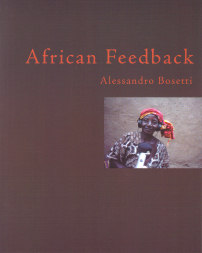
Errant Bodies Press en colaboración con Ground Fault Recordings presenta esta reciente y muy interesante publicación (CD+Libro) del compositor, saxofonista y artista sonoro italiano Alessandro Bosetti (1973- ). “African Feedback” tiene su origen en otoño de 2004, durante un viaje que el artista realizó por diferentes pueblos del oeste de África. Como ya hizo anteriormente en su composición text-sound ‘Il Fiore della Bocca’ (en aquella ocasión con individuos con diversos grados de incapacidad física y mental), Bosetti propuso a habitantes de Dogon Country (Mali), Yako y Ouagadougou (Burkina Faso), sesiones individualizadas de escucha de fragmentos de música experimental y poesía sonora. En el transcurso de las distintas audiciones el artista grabó toda la suerte de reacciones espontáneas, comentarios y descripciones que ofrecieron las personas expuestas a esos sonidos. Con las grabaciones obtenidas durante esa experiencia intercultural y otro material sonoro incorporado posteriormente, Bosetti compuso, entre enero y agosto de 2005, esta estupenda creación radiofónica que combina voces, lenguajes y música electroacústica. Producida por el propio artista en colaboración con La Muse en Circuit, “African Feedback” fue emitida por primera vez el 17 de marzo de 2006 en el programa de la radio pública alemana Deutschland Radio Kultur. “African Feedback” (CD+Libro): 1. ‘African Feedback’. El libro de 64 páginas incluye un breve texto de presentación del proyecto, las transcripciones en inglés de los comentarios obtenidos durante las distintas sesiones de escucha y numerosas fotografías

** texto extraido de arsonal (distribuidor en cuyo catálogo puede encontrarse esta publicación).

africanfeedback.jpg

Emotional Systems

Emotional Systems
From 30 november 2007 to 3 february 2008

The event marks the inauguration of the CCCS – CENTRE FOR CONTEMPORARY CULTURE CENTRE LA STROZZINA at the Palazzo Strozzi, a space: created as a platform for the vast range of practices that characterise contemporary art and culture.

The inaugural exhibition develops in three clearly distinct, yet complementary phases: an exhibition, a publication and a programme of lectures designed to investigate the topic of emotions, proposing a reinterpretation of the correlation between the contemporary artist, the work of art and the user, in the light of the latest discoveries in the neurological sciences about the human brain and its effects on the emotions.

Opening hours: 11.00 a.m. – 8.30 p.m. Closed on Mondays.
Tickets: €10.00 Admittance to Strozzina + Contromoda
€5,00 Strozzina (valid for 5 admittances in one month, lectures included)
€4,00 Schools

Emotional Systems - Press Release (36,59 Kb)

09.jpeg

Audio walking tour of Downtown Brooklyn

http://anyplacebrooklyn.com/

About
This audio walking tour of Downtown Brooklyn uses documentary sounds, interviews and guided observation to explore critical issues raised by the New York City’s Downtown Brooklyn Development Plan including: public space, democracy, eminent domain, freedom of expression and privatization.

The participant explores two very distinct areas of downtown Brooklyn: the small business area on and around Fulton Mall, and the privately-owned-public-space called Metro Tech Commons.

While experiencing highly contrasted versions of what public life in NYC can be, the participant learns that the city has passed the Downtown Brooklyn Development Plan to encourage more towering office and residential construction in the area, expanding the Metro Tech complex into the low-rise Fulton Mall area.

Through narration and interviews with area residents, activists and shoppers, this walking tour asks the listener to consider the anti-democratic nature of this urban planning process and the proposed plans effect on street and community life, while beginning to imagine the kind of public space and city they would like to live in.

Click here to download the 3 audio tracks needed for the tour

1814784750_18375769e2.jpg

La Conquista Invisible: Una historia cultural del Espacio Hertziano

La Conquista Invisible: Una historia cultural del Espacio Hertziano
Dentro de NOW: Encuentros en el Presente Continuo

Un proyecto de José Luis de Vicente para NOW | CCCB
Con Jonah Brucker-Cohen, Honor Harger, Armin Medosch y William J. Mitchell (videoconferencia)

Viernes 29 de Noviembre, 19:00h | Centro de Cultura Contemporánea de Barcelona | Montalegre 5, Barcelona | Entrada Libre
http://www.cccb.org/now

El espectro radioeléctrico –el espacio de ondas electromagnéticas por el que circulan emisiones de radio y TV, señales de telefonía móvil y GPS, redes de Wi-Fi…– es el suelo urbanizable de la sociedad de la información. Su progresiva colonización y conquista a lo largo del siglo xx ha transformado la articulación de las ciudades y las relaciones entre individuos. Sin embargo, sabemos muy poco sobre el espectro: quién lo posee, de qué manera se administra, cómo se deciden sus usos. A pesar de ser un recurso supuestamente escaso y precioso, su regulación está raramente sometida a procesos de escrutinio público.

A dos años del “apagón analógico” –la transformación de todas las emisiones de radio y TV en digitales–, cada vez más voces reclaman cambios profundos en el modelo de gestión del espectro para que se fomente su dimensión de espacio público y comunitario y se permita su acceso a cada vez más agentes sociales, ahora que todos somos en mayor o menor medida emisores. Los activistas por el “espectro abierto” plantean, además, que la escasez de frecuencias hertzianas que obliga a regular el sistema es herencia de un modelo tecnológico caduco que, de replantearse, podría abrir una nueva era de “ancho de banda infinito”.

Dialogan: Jonah Brucker-Cohen, artista digital conocido por sus proyectos que subvierten las arquitecturas de redes de comunicaciones, Honor Harger, miembro del colectivo radioqualia y experta en las lecturas culturales sobre el espectro, Armin Medosch, crítico y activista por el espectro abierto, y William J. Mitchell, catedrático de arquitectura del mit y uno de los más reconocidos expertos en las conexiones entre espacio urbano y espacio digital.

—–
Jonah Brucker-Cohen
http://www.coin-operated.com

Jonah Brucker-Cohen es investigador y artista. Actualmente es profesor adjunto en el Programa de Telecomunicaciones Interactivas de la Universidad de Nueva York. Desde 2006-2007 ha sido becario de investigación y desarrollo en el OpenLab de Eyebeam (Nueva York). Su tesis y sus trabajos se centran en el tema de la “deconstrucción de redes”, en que incluye proyectos dirigidos a cuestionar y desmontar de forma crítica percepciones ya aceptadas sobre la interacción y experiencia en redes. Sus escritos han aparecido en numerosas publicaciones internacionales, como WIRED Magazine , Make Magazine , Rhizome.org y Gizmodo.com, y sus trabajos se han podido ver expuestos en Art Futura, SIGGRAPH, Transmediale, ISEA, Ars Electronica y en el ZKM.

Honor Harger
http://www.radioqualia.net
http://www.avfest.co.uk

Honor Harger es artista y comisaria de exposiciones. Nació y estudió en Nueva Zelanda, y vive en Europa desde 1999. Es una de los dos artistas que dirigen r a d i o q u a l i a, un grupo de arte que trabaja en los ámbitos del arte digital y el arte radiofónico (net.radio). r a d i o q u a l i a ha expuesto en el NTT ICC de Tokio, el New Museum of Contemporary Art de Nueva York, el espacio Gallery 9 del Walker Art Center (Estados Unidos), la Maison Européenne de la Photographie de París (Francia), el Sónar de Barcelona y el Ars Electronica de Linz (Austria), entre otros. Actualmente, Harger también dirige el AV Festival del noreste de Inglaterra, y en el pasado trabajó para la Tate Modern (Reino Unido), ANAT (Australia) y Artspace (Nueva Zelanda).

Armin Medosch
http://www.thenextlayer.org

Armin Medosch es escritor, artista y comisario que trabaja en el campo del arte multimedia y la cultura de la red. En 2007 comisarió y presentó la conferencia de Ars Electronica “Goodbye Privacy” junto con Ina Zwerger. En 2006 comisarió la exposición “WAVES – electromagnetic waves as a material and medium of art”, junto con el centro RIXC de Riga. Medosch investiga la relación entre progreso tecnológico y cambio social, entre el arte multimedia y el software de código libre y abierto, entre las ondas electromagnéticas y el código. Actualmente construye una nueva plataforma investigadora de colaboración con el título “The Next Layer”. Sus libros incluyen Netzpiraten (2001) y Freie Netze (2003).

William J. Mitchell
http://web.media.mit.edu/~wjm/

William J. Mitchell es profesor de la cátedra Alexander Dreyfoos de Arquitectura y de Artes y Ciencias de la Comunicación en el MIT, director del laboratorio de diseño del MIT y director del grupo de investigación Smart Cities del Laboratorio de Medios del MIT. Sus investigaciones se centran en nuevas estrategias para la producción y el diseño arquitectónicos, los medios de comunicación digitales, y las ciudades en la era de las grandes redes digitales.
Entre sus publicaciones cabe mencionar: Imagining MIT: Designing a Campus for the 21st Century (2007), Placing Words: Symbols, Space, and the City (2005), City of Bits: Space, Place, and the Infobahn (1995) y The Reconfigured Eye: Visual Truth in the Post-Photographic Era (1992), todas ellas editadas por MIT Press. De 1992 a 2003 fue decano de la Facultad de Arquitectura y Planificación del MIT

ps/ José Luis de Vicente comisarió para ZEMOS98 [octava edición] “Reclaim the Spectrum”

London Noise Map

http://81.187.187.47/

the London road traffic noise map
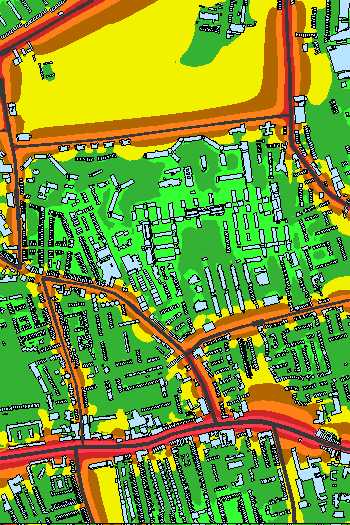
The London Road Traffic Noise Map is just one element of the Government’s much wider national ambient noise strategy. It will provide information on the levels of road traffic noise across the whole of the Greater London Authority’s area. Other types of noise will be covered by projects that are being planned or progressed at present.

Although road traffic noise is only one type of noise that affects people, it is a concern for more Londoners than any other individual source of noise. In the London Household Survey undertaken by the GLA in 2002, 13 % of Londoners said that road traffic noise was a serious problem, compared with 6 % who said that aircraft noise was a serious problem and 4 % who considered that noisy neighbours were a serious problem. At the same time, there is a need to protect existing areas of tranquillity from erosion.

Noise maps will help to establish the existing baseline so that we will be able to measure the effectiveness of future initiatives to control noise. They will also let us see in an understandable and visual way how noise spreads from roads and into residential areas. They will help us to see how different types of building layout can affect the spread of noise, the havens of quiet that already exist within the city, and how careful planning could create more of them.

Noise maps will help non-specialists develop a more intuitive feel for how noise behaves, which will allow more people to appreciate the importance of planning and designing against noise and to let them become involved in the process. They will also give experts the tools to refine designs for maximum benefit at affordable cost.

The London Noise Map is the first detailed noise map of the whole of London and is necessarily limited by the availability of some types of information. But at the same time, it is forming a focus for gathering together the huge body of information already available into a coherent set of data. The map is a live resource that can answer many of the questions which will arise as people continue to look for measures to better manage the noise we create.

waves1.jpg

Radio program: framework, by Patrick Mcginley

http://murmer.soundtransit.nl/radio.html

framework
phonography/field recording; contextual and decontextualized sound activity
presented by patrick mcginley

framework broadcasts sundays locally in london (uk)
and worldwide online at resonance104.4fm from 9-10pm gmt
converter for local broadcast times

framework has been on the air since june, 2002, featuring regular editions of new and old field recordings and field recording based composition, live on-air performances, and special editions such as framework:focus, which features the work of a single artist, project or theme in a continuous hour-long soundscape, and framework:afield, a series of programs curated and produced by guest artists from around the world. each regular edition begins with an introduction recorded by a listener - you can find guidelines on submitting an introduction through the link below. via the links above, you can find a complete collection of our past playlists. you can join our mailing list below (or email directly) to receive regular playlists and announcements. you can now stream the latest edition or subscribe to our podcast from the links above. if you’d like to submit material for airplay, or if you have a proposition for a live performance or an edition of framework:focus, please contact us.

Stream the latest edition

waves.jpg

Giga-Hertz Award for Electronic Music + Symposium “c3ubic: Sound in Space+”

http://www.giga-hertz-preis.de/

In 2007, the ZKM | Institute for Music and Acoustics and the EXPERIMENTALSTUDIO for acoustic art in Freiburg inaugurated the annual Giga-Hertz-Award for electronic music. This new international music award with its future-oriented concept exists thanks to the initiative and commitment of ZKM director Peter Weibel. The award is funded by the city of Karlsruhe and the Federal State of Baden-Württemberg.

The Giga-Hertz-Award addresses composers working in the areas of electronic and acousmatic music. A Grand Prize and four Special Prizes are awarded once a year by an international jury. The Grand Prize honors the artistic achievements of outstanding composers. It is not awarded in the framework of a public competition but selected from the nominations of the jury members. The four Special Prizes serve to initiate and support new projects, and are aimed especially at young composers in electronic and acousmatic music.

The Giga-Hertz-Award is in memory of the world-famous physicist Heinrich Hertz (1857–1894), who taught at the Karlsruhe technical university at the end of the nineteenth century; it was there that he discovered electromagnetic waves.

This award for electronic and acousmatic compositions is unique in Germany and underlines the importance of electronic music, especially in Baden-Württemberg: the award is supported by the most important German studios for electronic music — Freiburg’s EXPERIMENTALSTUDIO for acoustic art and the ZKM | Institute for Music and Acoustics (IMA) in Karlsruhe. The patron of the Giga-Hertz-Award is the Minister-President of Baden-Württemberg Guenther H. Oettinger.

On Saturday, 23 June 2007, the first winners of the Giga-Hertz-Award for electronic music were announced by the ZKM | Centre for Art and Media Karlsruhe and the EXPERIMENTALSTUDIO for acoustic art Freiburg. The Giga-Hertz-Award, with prize money of € 47,000, is the highest worldwide for an electronic music award.

The Grand Prize of € 15,000 goes to the British composer Jonathan Harvey for his extensive oeuvre at the interface between electronic and instrumental music. The four Special Prizes, each worth € 8,000, go to the French composer Mark Andre, Daniel Mayer from Austria, Flo Menezes from Brazil, and Vassos Nicolaou from Cyprus, who lives in Cologne.

The Special Prizes are grants with which the artists will be able to realize their submitted, prize-winning projects, either at the ZKM | Institute for Music and Acoustics or the EXPERIMENTALSTUDIO for acoustic art in Freiburg.

The Awards Ceremony with the artists will take place on 24 November 2007 at 20.00 hrs. at the ZKM | Centre for Art and Media Karlsruhe. There will be a supporting program with concerts and a symposium, “c³ubic: Sound in Space ” [+programme info here].

gigahertzaward.jpg

SuperCollider 3.1 +++

Desde el pasado 31 de Octubre está disponible una nueva versión de SuperCollider, con varios cambios y mejoras.

http://supercollider.sourceforge.net/

SuperCollider is an environment and programming language for real time audio synthesis and algorithmic composition. It provides an interpreted object-oriented language which functions as a network client to a state of the art, realtime sound synthesis server.

SuperCollider was written by James McCartney (audiosynth.com) over a period of many years. It is now an open source GPL’d project maintained and developed by James and various others. It is used by musicians, scientists, and artists working with sound. For some background, see SuperCollider described by Wikipedia.

SC es un proyecto open source mantenido por una amplia comunidad de usuarios y desarrolladores, por lo tanto hay bastante documentación en la red para aprender este entorno.

Nick Collins, profesor en la Universidad de Sussex y conocido experto en SuperCollider, ofrece públicamente desde su web los materiales empleados en los cursos que imparte, y que son muy interesantes para comenzar a trabajar con este potente entorno. Otro lugar que visitar es la SuperCollider Wiki

[Nick Collins - Computational Music 1 - SC Course]

Y si os pilla por Madrid, el próximo lunes día 26 habrá un mini-curso de iniciación a SuperCollider que será impartido por Sergio Luque, dentro de la programación formativa que cada año por estas fechas se celebra en el CDMC. El martes 27 también estará por allí Enrique Tomás (miembro de mediateletipos), hablando de PureData y Arduino.

800px-supercollider_screenshot2.jpg