Bruce Haack : the king of techno

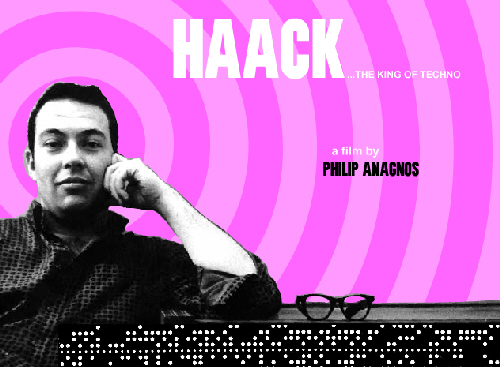
Estos días ha aparecido por google video el documental del 2004, Bruce Haack: The king of techno, dirigido por Philip Anagnos. En él se presenta la vida de este poco conocido pionero de la música electrónica, de origen canadiense, desaparecido en 1988.

http://www.brucehaack.com/

[ver el documental / watch the movie]

Bruce Haack, born on May 4, 1931, was one of the most musically and lyrically inventive children’s songwriters of the ’60s and ’70s. Despite — or perhaps because of — his intended audience, his music was unusually expressive, combining homemade analog synths; classical, country, pop, and rock elements; and surreal, idealistic lyrics. Haack’s innovations and desire to teach still sound fresh, making his music a favorite with fans of analog synths and esoteric recordings. Followers like Luke Vibert and Add N to X championed his unique musical vision, which embraced concepts like “powerlove” and turned household appliances into synthesizers and modulators.

Vía: audio mastermind

bruce_haack_documentary.jpg

Phonethica

En neural.it, Francesca Tomassini nos presenta Phonethica, un interesante proyecto de Nao Tokui sobre las coincidencias fonéticas entre los lenguajes del mundo.

Phonethica by Nao Tokui is a project that identifies homophones in the more than six thousands existing world languages. It’s a cross-disciplinary project that, reconciling art and science, propose an innovative key to the reading of the magmatic contemporary culture. Homophony is the projects’ fulcrum, and the system measures it basing on the International Phonetic Alphabet’s scale of values. The research process most interesting aspect is to discover that the words or expressions’ similar sounds in two or more different languages, do not match a respective semantic analogy. So when the system connects these words and expressions, also known as ‘false friends’, it brings also cultural information about people speaking that specific language. In this way the two omophones’ comparison becomes a potential input to prepare the individual to new cultures awareness. The artist has amplified this possibility realizing an interactive installation (Rondo), testable at the Tokyo ICC till March 2007, that allows the user to value the spatial distances of the similar linguistic origins through a software interface and a speaker that revolves on a circular track, simulating the origin location. The - linguistic so cultural - similarity/alterity dichotomy becomes then the line on which the social relationships equilibrium is calibrated. Diversity is never more only a question of accepting each other or pacific cohabitation, but it becomes the ‘trait d’union’ amongst the most disparate cultures.

Project Phonethica

http://www.phonethica.net/

Combining scientific technology and art, Phonethica is an interdisciplinary project which explores the diversity of the world, through the phonetics of its 6,000 languages.

logotype.png

Qué es mediateletipos.net?

En las Charlas Open Zemos mediateletipos.net y el resto del Cluster Sonoro presentó sus manifestos, intenciones y credenciales. Fue en marzo de este año, en Sevilla, dentro de las actividades del Festival ZEMOS98.

La charla dura algo más de 40 minutos y describe con detalle lo que somos, lo que aspiramos a ser y es al mismo tiempo una llamada a colaborar con nosotros.

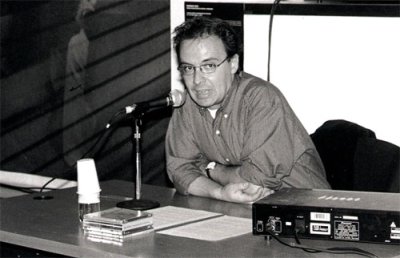
ESCUCHARLA (ver foto)

Otras charlas en Open Zemos

teletipes.jpg

COMENTARIOS A CIERTO REPERTORIO PAISAJÍSTICO

Buscando informaciones, textos y otros elementos relacionados con el paisajismo sonoro me encontré con este estupendo paseo sonoro (en formato texto) del ya clásico Ferrán Cuadras. Disfrutadlo:

“Grabar sonidos es colocar un marco alrededor de los mismos. De la misma forma que una fotografía enmarca un determinado entorno visual que puede ser analizado detallada y cómodamente, una grabación sonora asila un entorno acústico y lo convierte en un evento repetible, susceptible de ser examinado”, apuntaba el director del World Soundscape Project, Ray Murray Schafer, en 1973. Palabras idóneas para introducir y caracterizar el repertorio sonoro que será objeto de comentario en las siguientes líneas. […]

más…

cuadras.jpg

Undersound

http://www.undersound.org/

“Undersound is a new type of experience, an interface that is on your mobile phone and in the underground stations you pass through every day.[…] undersound will be spatially distributed at individual stations and throughout the wider tube network. I can add music to the system at upload points in the ticket halls , and I can download tracks on the platforms. Architectural configuration of the stations affects my experience of contributing and downloading music as the proximal nature of the interaction with these situated points require s myself and other undersound users to congregate at certain locations within the station for the purpose of interacting with the system […] Because the system will be gathering metadata on the stations where the track has been (via uploading/downloading at the transfer points) and thus its spread within the network, the time it has been in the system, the number of times it has been played, the number of people who have played it, and so on, I will be able to see this information when I look at other people’s music […] Every time I listen to a track, drop one off at transfer point or download music from someone else, I have an effect on the overall state of the system. Not only is this reflected in the rankings of the tracks that I see as I browse through the lists of available music from download points and people’s mobile phones but it will also be incorporated into public displays which are installed in each of the stations […]”.

Via: www.newscientist.com/

DONDE Y DURANTE

info

El régimen audiovisual del web art siempre fue paradigma de un orden del tiempo no basado en la sucesión, sino en relaciones interiores de tiempo, en la línea de la imagen-tiempo que fuera redefinida (tomando el término de Bergson) por Gilles Deleuze. Evolución de ese “reino de los inconmensurables” o de los “cortes irracionales” que instaurara la cinematografía más ambiciosa de la segunda mitad del siglo XX (ésa en la que el tiempo habría perdido “los estribos” presentándose en “estado puro”) la imagen-tiempo encontrará en el campo electrónico su mejor contexto para desarrollarse. De hecho, Deleuze aseguraba la importancia futura del descubrimiento bergsoniano de una imagen-tiempo, convencido en 1983 de que aún quedaban “por despejar muchas de sus consecuencias”. De forma más concreta, su vaticinio acerca de las imágenes electrónicas, que según afirmaba “cimentarían en aspectos no conocidos aún de la imagen tiempo” parece hoy un hecho especialmente patente en la producción artística on line.
Tratando de constatar esta situación, se presentan aquí una serie de obras que inciden en ese método del ENTRE deleuziano (“entre dos imágenes”), haciendo visible lo que es indiscernible, su espaciamiento, liberando intersticios e intervalos, la coexistencia del antes y el después con la imagen, es decir, intentos de una presentación directa del tiempo, o, dicho de otra manera, más “mostraje” del tiempo que “montaje” en el tiempo. Pues la fluidez deslizante de un tiempo que separa los acontecimientos y sus dinámicas, pero sólo como en un motor la grasa separa piezas que se mueven a distinta velocidad o de forma contrapuesta es una de las más importantes características de estas obras. Despojadas de nexos de fuerza entre las imágenes que las integran, las relaciones entre éstas no son de necesidad sino siempre de atracción, variables en sus intensidades, instantáneas en sus acuerdos. Un nuevo fin del tiempo como el orden de los fenómenos sucesivos, en la invitación a un nuevo, extraño y fascinante ejercicio de exposición de sus espectadores a simultaneidades totales.

sarm.jpg

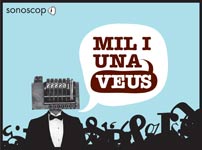
MIL I UNA VEUS

MIL I UNA VEUS

info

Los próximos 3 y 4 de novembre se presentará en el CCCB (Centre de Cultura Contemporània de Barcelona) el festival de arte sonoro MIL I UNA VEUS, organizado por la Orquestra del Caos y centrado en la exploración de los usos artísticos no convencionales de la voz humana.
Encontraréis a David Moss, José Iges, Bartolomé Ferrando y Eduard Escoffet, en directo, además de una selección de más de 150 obras sonoras de otros artistas, organizadas en cuatro colecciones consultables individualmente: “Text Sound”, “Radio Radio”, “Linebreak”, “Música electroacústica i veu” y “Camí fressat : itineraris per les escriptures contemporànies”; y dos colecciones para la audición pública continua con ocho altavoces: “Le sixte livre dit éléctroacoustique de François Rabelais” (GMEB) y “Octofonías para Voces” (Simon Fraser University).
Con entrevistas y obras de : Charles Amirkhanian, Bruce Andrews, Paul Auster, Milton Babbitt, Michael Basinski, Jacques Bekaert, Françoise Barrière, José Manuel Berenguer, Charles Bernstein, Lars-Gunnar Bodin, Rainer Boesh, Pierre Boeswilwald, Bufffluxus, William Burroughs, cris cheek, Michel Chion, Henry Chopin, Bob Cobbing, Robert Creeley, Hugh Davies, Francis Dhomont, Jane Draycott & Elizabeth James, Stephen Erickson, Barbara Guest, Ray Federman, Ben Friedlander, Madeline Gins, Sten Hanson, Carla Harryman, Georg Katzer, Leo Kupper, Lyn Hejinian, Ake Hodell, Susan Howe, Bengt Emil Johnson, Sianed Jones, Sherwood Lazier, Karen Maccormack, Steve Mccaffery, Jennifer & Kevin McCoy, Jackson Maclow, Christof Migone, Paul D. Miller (a.k.a DJ Spooky), Robert Normandeau, Lance i Andrea Olsen, Jena Osman, John Oswald, Ted Pearson, Piers Plowright, Michel Redolfi, Roger Reynolds, Jerome Rothenberg, Leslie Scalapino, Ron Silliman,J.A. da Silva, Martin Spinelli, Peter Straub, Ulrich Suesse, Luci Tapahonso, Dennis Tedlock, Fiona Templeton, Daniel Teruggi, Daniel Tosi, Barry Truax, Lawrence Upton, Ben Yarmolinsky, Cecilia Vicuña, Hannah Weiner, Hildegard Westerkamp, Gregory Whitehead, Ben Wilson y Trevor Wishart.

miliunavoces1.jpg

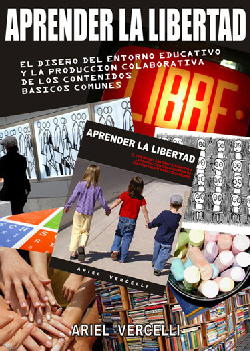
Aprender la libertad

http://www.aprenderlalibertad.org/
http://nomada.blogs.com/jfreire/2006/08/cmo_la_propieda.html

Tirando del hilo desde la lista de correo copyleft-arte llegamos al blog de Juan Freire, donde habla de “Aprender la libertad: el diseño del entorno educativo y la producción colaborativa de los contenidos básicos comunes”; libro publicado en enero del 2006 por el argentino Ariel Vercelli y disponible para su descarga bajo una licencia creative commons.

dice Juan Freire:

En pocos ámbitos es tan importante la creatividad y la libertad para compartir y reutilizar información y conocimiento como en la educación … y en pocos ámbitos los derechos de propiedad intelectual han logrado alcanzar grados de restricción tan elevados que ha desembocado, hasta hace bien poco, en la ausencia casi total de estándares abiertos y modelos colaborativos dentro de las comunidades educativas. Dos publicaciones recientes se enfrentan a las oportunidades que genera la tecnología digital, poniendo de manifiesto que para convertirse en realidad existe una necesidad urgente de superar los modelos de copyright tradicionales para proporcionar libertad de acceso, transferencia de conocimeinto y “remezcla” en la educación.

el resumen del libro :

Aprender la libertad: El diseño del entorno educativo y la producción colaborativa de los contenidos básicos comunes’ es una obra que invita a analizar la relación estratégica que existe entre las tecnologías digitales e Internet y la planificación superior de los sistemas educativos. La obra explora las características más relevantes de esta relación y desarrolla un marco teórico-conceptual para comprender su alcance. El trabajo caracteriza los bienes intelectuales comunes y describe su potencial para la producción colaborativa de contenidos educativos en la era digital. Finalmente, analiza el Sistema Nacional de Educación de la República Argentina y acerca soluciones para producir colaborativamente estos contenidos. La obra propone el diseño de un entorno educativo de carácter abierto e incluyente que permita aprender la libertad como un elemento vital para la formación de las generaciones futuras.

aprender_libertad.jpg

Netlach 06

Netlach 2006

Encuentro de cibercultura crítica y nuevos medios de Bilbao
del 10 al 18 de noviembre 2006

cibercultura | reality hacking | nuevos medios | net radios | biotecnología | activismo mediático | software libre | comunidades virtuales | robótica | artivismo | cultura hacker | science art | ciberfeminismo | blogosfera | teles libres | redes inalámbricas

http://www.netlach.org/

>> PROGRAMA:

Jueves 9 noviembre | Spazzio Grossi
* 20h:00 Net Mail: del arte correo al network digital. Inauguración de la exposición y presentación del NetLach 06.

Viernes 10 de noviembre | Anti-liburudenda
* 20h00 Eguzki Bideoak.

Sábado 11 de noviembre | Anti-liburudenda
* 20h00 Res-qualia: evolución y percepción. Arte en la era postbiológica.
* 21h00 Generación Robótica: ¿re-engrasar el tecnocapitalismo o subvertir la gran maquinaria?.

Lunes 13 de noviembre | UPV-Leioa Facultad de Bellas Artes aula A8
* 15h30 – 18h30 Net-radio. ¡Crea tu radio casera!

Martes 14 de noviembre | UPV-Leioa Facultad de Bellas Artes aula A8
* 10h00 – 13h00 Net-radio. ¡Crea tu radio casera!

Miércoles 15 de noviembre | UPV-Leioa Facultad de Bellas Artes
* 10h00 Nevermind the blogs!.

Jueves 16 de noviembre | Anti-liburudenda
* 20h00 Radioswap
* 21h00 Wiki-plaza

Viernes 17 de noviembre | Anti-liburudenda
* 20h00 El reciclaje informático: mitos y realidades.
* 21h00 Stream.communa

Viernes 17 de noviembre | Bilbaoarte
* 16h30 – 19h30 Podcasting.

Sábado 18 de noviembre | Anti-liburudenda
* 20h00 Data Aesthetics
* 21h00 Candida TV

Sábado 18 de noviembre |
* 22h30 Señorita Cyborg | Churruca aka MC Mefisto Negruri multimedia. [Netlachfest] audio | proyección | performance.

netlach06.jpg

Pianoless Vexations en UBU

http://www.ubu.com/sound/vexations.html

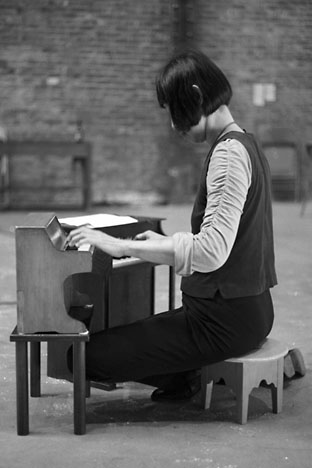
Pianoless Vexations, an eight-hour performance of Erik Satie’s Vexations (1893) was performed at The Sculpture Center in New York City on Sunday, June 11, 2006, 11-7pm.

Vexations was composed by Erik Satie in 1893 and consists of a short motif repeated 840 times. Satie directs on the score: “In order to play this motif 840 times consecutively to oneself, it will be useful to prepare oneself beforehand, and in utter silence, by grave immobilities.” Vexations was first performed publicly by John Cage and several other pianists over the course of 19 hours in 1963. As the title conveys, artists performing in Pianoless Vexations used any instrument except the piano to perform Satie’s original composition. Instruments included laptops, drums, guitar, French horn, violin, trumpet, saxophone, viola, recorder, toy piano, harpsichord, mandolin, bass, film projectors, voice, dulcimer and more. Artists will performed in continuous twenty-minute segments throughout the day.

Pianoless Vexations was conceived for “Grey Flags” exhibition at The Sculpture Center by Kenneth Goldsmith; Musical Directors and Curators Frank J. Oteri, Alan Licht, and Anthony Huberman. Michael Dotolo was the sound engineer.

satie-17-margaret-leng-tan.jpg

telephone helpline of inspiring sounds

[BBC News]

A telephone helpline of “inspiring” sounds has been launched for those suffering from the winter blues.

As the clocks go back this weekend, the Lake District’s tourism bosses have recorded tranquil sounds to encourage visitors and stave off depression.

The Lakes’ Escape Line includes a reading of Wordsworth’s Daffodils, the sound of water lapping at Windermere and a sizzling Cumberland sausage.

The helpline also contains information on accommodation in the Lake District.

As well as to promote the region, it was set up to lift spirits and remind listeners that the outdoors can still be enjoyed during the winter months.

Eric Robson, of Cumbria Tourism, said: “Few of us enjoy getting up in the dark or coming home in it, so making the most of daylight and how you spend your weekends could be important for keeping the winter blues at bay.”

Dr Marcus Roberts, head of policy at mental health charity Mind, said: “What your parents said is true - fresh air and exercise are good for you, for your mind as well as your body, particularly in winter.”

escapeline_sausage.jpg
** The line features the sound of sizzling Cumberland sausages

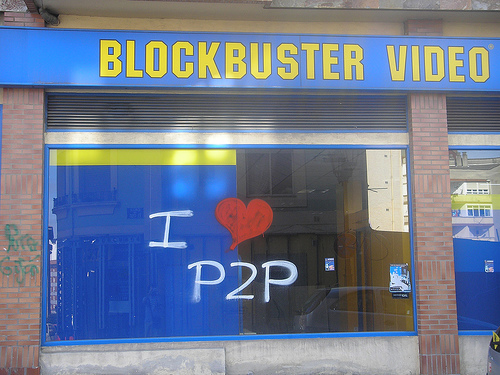
I love P2P

Una declaración de amor en toda regla

227241974_f988dc934b.jpg

[vía]

contra la Bienal de Arte Contemporáneo de Sevilla

Toda la información en los CONTRAPUNTOS de la PRPC a la BIACS. Y seguimos en www.e-sevilla.org

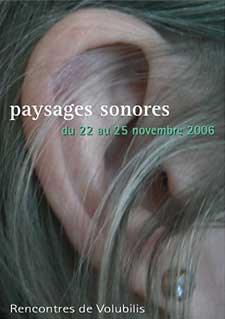
volubilis - paysage sonore 2006

http://www.volubilis.org
7e édition de rencontres euro-méditerranéennes sur le thème des paysages sonores.
Avignon du 22 au 25 novembre 2006.
Programme sur PDF ici

Algunas preguntas interesantes que lanza el proyecto:

- Qu’est-ce qu’un espace sonore, comment se constitue-t-il et quelle en est la perception ? Est-elle culturelle autant que physique et a-t-on le droit d’en parler comme d’un paysage et, comme lui, prévoir de le projeter ?
- Quelles sont nos capacités et incapacités d’écoute ? Sait-on entendre (s’entendre ?) sans attention ni travail ce paysage sonore que nous habitons ? Sommes-nous égaux et identiques, avons-nous tous la même oreille d’un bout à l’autre du monde ?
- Les sons, les bruits, les ambiances sonores de la cité, de l’usine, des champs ou de la nature, nouveaux matériaux pour une musicalisation du paysage sonore ?
- Dans le monde apeuré par la globalisation qui broie la diversité et les identités, les inventaires et la patrimonialisation des paysages sonores (programme de l’UNESCO) à l’instar des paysages et des patrimoines bâtis ou ethnologiques, ont-ils un sens ?

rubon51.jpg

Industria musical y South Park

Si aun no lo has visto no te pierdas el episodio de South Park sobre el maravilloso mundo de la industria musical. Lo han subido subtitulado a YouTube con el título de “Parque del Sur y la SGAE”…

Puedes verlo aquí: aquí