media·teletipos, fluyendo en paralelo

|

media teletipos , la otra parte de este proyecto

Recordaros que Pedro Jiménez gestiona el proyecto paralelo a “audio·teletipos”. Este artista sonoro ha creado “Video.teletipos“, un servidor de teletipos similar a este que se puede consultar y sindicar de forma autónoma.

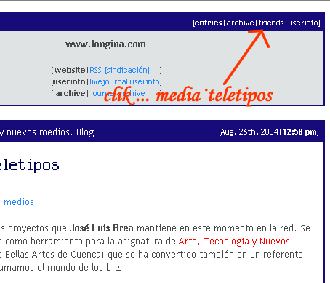
Podeis acceder directamente desde este lugar, clikeando en “friends” (ver imagen). Los dos proyectos, audio y media·teletipos, responden a una necesidad de informar de forma libre sobre los puntos calientes del mundo del audio y la imagen. Es nuestro modo de agradecer la apabullante generosidad de la red con todos nosotros, devolver una pequeña parte de lo que hemos recogido en estos años y también es nuestro frente común para cambiar ciertos aspectos de la sociedad que están profundamente tocados de muerte. Los dos creemos en la vida digital como la nueva meca (me refiero a que hace 20 años la peña viajaba a la india y a lo oriental buscando respuestas y ahora esa meca está en la red), y para nosotros este blog significa una ventana abierta a nuestro discurso personal, a la que todo el mundo puede asomarse. Defendemos la libertad de creación y la inteligencia colectiva; el derecho a decidir sobre el destino de tu propia obra. Estamos convencidos (a pesar de haber pasado la edad del pavo) de que todavía se puede creer en un presente vivo, desconectado de la corriente capitalista mal entendida, y hemos optado en nuestra vida por entregarnos a ello de modo incondicional. Estooo, disculpas por el discursito, pero lo necesitaba.

Estas son las direcciones para sindicarse a los dos lugares:
sindicación video teletipos: http://www.livejournal.com/users/videoteletipos/rss/
sindicación audio teletipos: http://www.livejournal.com/users/audioteletipos/rss/

mediateletipos.gif

Mi viaje a Cuenca y mi desconexión

|

Aunque resulte increible, no he podido conectarme en estos dos últimos días. Ni yo mismo me lo creo, vamos. Dos días sin asomarme a la red… NO ME LO PUEDO CREER.

El caso es que ha comenzado “el viaje” del que tanto he hablado este año; el motivo de mi excedencia en el mundo profesional del audio. Para los que se han incorporado recientemente (y si tienen interés), comentar que este blog ha sido diseñado para ser testigo del tiempo real (o casi) de mi “viaje” en busca del conocimiento. Suena a “pirao”, lo se, pero después de dejarme seducir por las enseñanzas de Gurdjieff y quedarme tan pillado con sus danzas sagradas (ya os hablaré de este tema) y ahora retomar al Castaneda más alegre (en Cuenca estudio Antropología), creo que he vuelto a pecar y me da exactamente igual. La Antropología del sonido es mi objetivo (que no de la música).

Desde el mes de abril y hasta hoy audio-teletipos se ha convertido de alguna manera en un noticiario breve del mundo del sonido digital, una máquina de teletipos de sonido (muchos de ellos sonoros). Esta “linea” continuará, aunque también contaré mi vida en Cuenca y mis descubrimientos personales más íntimos (uffff), algo parecido al diario que publiqué en su día desde Escocia, al que llamé Lomondscape (http://www.longina.com/diario_lomondscape/diario.html) , pero eso si, con menos intensidad que aquel, porque tampoco se trata de despelotarse de ese modo.

Todos los edificios de la Universidad de Cuenca están equipados con antenas wifi y la conexión es de 11mbs a la red iris, así que estoy cubierto, ja, ja, ja. Pero todavía no he podido conectarme por un problema de contraseña. Me aseguran que el día 1 estará operativa para mi, así que hasta ese día no podré enseñaros las fotos del viaje, mi casa y las cositas que fotografíe aquí. Todo el mundo atento, que aunque breve y mínimo, este blog será caliente e intenso.

(ehhhh!!! Amiguetes de mi galicia, os quiero)

serie_london2.jpg

SINSALradio. Program n43. ART BY TELEPHONE

|

sinsalradio

data.date 25.septem.2004__
ART BY TELEPHONE: l969. 44’00″
[ubuWeb Sound Archive]

Shortly after its opening, the Museum of Contemporary Art planned an exhibition to record the trend, incipient then and pervasive today, toward conceptualization of art. This exhibition, scheduled for the spring of 1968 and abandoned because of technical difficulties, consisted of works in different media, conceived by artists in this country and Europe and executed in Chicago on their behalf. The telephone was designated the most fitting means of communication in relaying instructions to those entrusted with fabrication of the artists’ projects or enactment of their ideas. To heighten the challenge of a wholly verbal exchange, drawings, blueprints or written descriptions were avoided. -Jan van der Marck (covertext)

Participating artists: Siah Armajani, Richard Artschwager, John Baldessari, Iain Baxter, Mel Bochner, Geoge Brecht, Jack Burnham, James Lee Byars, Robert H. Cumming, Francoise Dallegret, Jan Dibbets, John Giorno, Robert Grosvenor, Hans Haacke, Richard Hamilton, Dick Higgins, Davi Det Hompson, Robert Huot, Alani Jacquet, Ed Kienholz, Joseph Kosuth, Les Levine, Sol LeWitt, Robert Morris, Bruce Nauman, Claes Oldenburg, Dennis Oppenheim, Richard Serra, Robert Smithson, Guenther Uecker, Stan Van Der Beek, Bernar Venet, Frank Lincoln, Viner Wolf Vostell, William Wegman, William T. Wiley.

Cover: b/w, gatefold, documentation-photo, texts about the artists and an introduction by Jan van der Marck. Design: Sherman Mutchnick.
>>>>>>>>>>
>>>>>
>>>
>>
>

Aparca el coche y relájate

|

Aparca aquí

Despedimos la semana y aparcamos el cacharro. Este lunes estaré ya viviendo en Cuenca, un gran cambio en mi vida. Ya sabeis, me voy de retirada espiritual, a buscar algo que todavía no conozco.

Ah, para aparcar usad los cursores. Piiiiiiii, piiiiiiii

aparcar.gif

Cityphonics. Archivo sonoro online.

|

La orquesta del Caos nos presenta Cityphonics, un lugar sencillo que contiene soundscapes y otras obras sonoras interesantes (Henri Pousseur, Erik La Casa, Chris Brown, etc). El interface está basado en flash y resulta, aunque poco estético, muy práctico. Eso si, las obras son muy cortas y lupeadas, una pena. Que crezca.

PRESENTACIÓN:
En la acrópolis de Atenas, hay un letrero que dice: -Este es un lugar sagrado. Está prohibido cantar o hacer ruidos fuertes de cualquier especie-. Hoy, mientras estábamos allí, 17 jets pasaron rozando la acrópolis.

R.Murray Shaefer

El archivo de proyectos sonoros SONOSCOP viene prestando, desde hace años, un especial interés en recoger trabajos hechos en torno a los paisajes sonoros. En el año 2002 decidimos dedicar el décimo simposio de música electroacústica ,En red O, a los paisajes sonoros urbanos. Esta es una muestra ampliada de aquella selección que expone muchas formas de escuchar, entender y procesar el sonido de las ciudades.

E-mediateca presenta este site dedicado a la consulta, archivo, difusión y divulgación de proyectos sonoros del fondo SONOSCOP. Dichos proyectos forman parte de los contenidos temáticos preferenciales de la Mediateca, por ello se presentan en formatos interactivos que incentiven y realcen su consulta, creando un espacio virtual en mediatecaonline para alojar y poner en circulación estos archivos sonoros que pasan a formar parte del archivo permanente.

cityphonics.gif

Spectropilis Festival [ny]

|

http://www.spectropolis.info/

LITERAL:
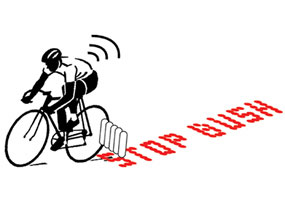
Spectropolis projects are wide-ranging experiences from screen-based interactions to audio narratives and physical installations. Most projects will be presented outdoors in Manhattan’s City Hall Park from 12:00 until 4:00 pm October 1, 2 and 3 unless otherwise specified. Spectropolis projects include a portable hearing device that transmits a soundscape responding to immediate surroundings, an artificial flower that indicates the availability of wireless internet activity through luminescent color patterns, a wired bicycle that chalks text messages from the web onto city streets and a computer station for free download of digital art ephemera. For complete project descriptions, follow the links below.

bikespectropolis.jpg

Natural Process. Flow by exodemo

|

Natural process

LITERAL:
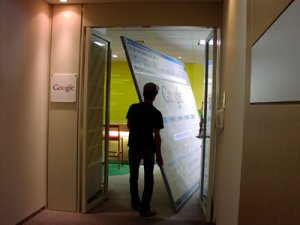
“Natural Process (NP)” is an installation that consists of exonemo’s first-ever pictorial work, “A web page,” and a surrounding system.

“A web page,” the work at the center of this installation, is a conversion of a well-known webpage (*1) into painted form. Simply put, the painting depicts an entire webpage along with the window that frames it! Yet, at the same time, it’s not just a painting, but also “an analogization of a digital object” or “a landscape painting of the Internet.” (After all, we see it through a “window”!)

The NP system is constructed so that a webcam captures the painting in the museum and transmits its image onto the Internet. Here’s how it works:
[The webpage is converted into analog form (i.e. a painting)] >> [installed in the museum] >> [filtered through the medium of the exhibition space] >> [converted back into digital form] >> [and transmitted onto the Internet]
In short, it originates from the Web and returns back to it through what is probably the world’s most-roundabout process ever!!
And by filtering through the medium of the museum, will the “data” deteriorate? Or will it mature into something else!!!!!!?

Will you come see the “real” webpage painting at the museum?
Or will you see it “virtual” through the Web?
– Natural Process system chart–

Webpage
+——-+
| |
| | museum
+——-+ +———————————+
| | |
| | +————–+ |
+——-+->| | |
convert | | | | +——-+
| | | | | | | |
| | | < ----- * ---+---| |---> | |
| | painting | camera | | | +——-+
| +————–+ | internet PC(home)
| |
+———————————+

*1 We chose the Google.com website as the subject of our painting. Google is a revolutionary search engine that burst onto the world of the Internet in 1998 when it was still finding its way, bringing a definitive change to the nature of the Internet thereafter. We chose it as the quintessential landscape of the Web as our way of paying tribute to the site. Google Rocks!!

* Neither “Natural Process” nor “A web page” has any affiliations with Google Inc.

googleart.jpg

The Wall Street Journal. C. Commons

|

Noticia

LITERAL:
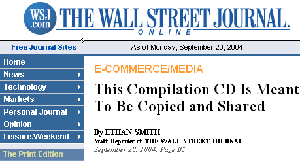
This Compilation CD Is Meant, To Be Copied and Shared
By ETHAN SMITH
Staff Reporter of THE WALL STREET JOURNAL
September 20, 2004; Page B1

[...] For more than a year, the music industry has held firm on its zero-tolerance position on online file swapping, suing 4,679 alleged digital pirates to drive its point home.
But now, 16 high-profile artists, many of them signed to the same global music companies that have brought the lawsuits, are participating in a project that will allow music lovers to freely copy and trade some new songs without risking legal retaliation.

Next month, songs by the Beastie Boys, David Byrne and 14 others will appear on a compilation CD whose contents are meant to be copied freely online, remixed or sampled by other artists for use in their own new recordings. “The Wired CD: Rip. Sample. Mash. Share.” was compiled by the editors of Wired magazine, of San Francisco, as an experimental implementation of a new kind of intellectual-property license called Creative Commons. About 750,000 copies of the disc are to be distributed free with the magazine’s November issue. The disc also will be handed out to audience members at a benefit concert by Mr. Byrne and others tomorrow night in New York [...]

wsjournal.gif

Michel Waisvisz

|

http://www.crackle.org/

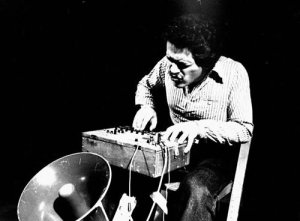
Y aquí un homenaje a uno de los padres del HCI [human computer interface], hablo de Michel Waisvisz. Tengo un video de uno de sus workshops, y recuerdo también que aparece con generosidad en el video francés Sonic Scopes, fácil de conseguir por p2p. Es el creador de Steim.

Fuente: J.G

cracklesynth.jpg

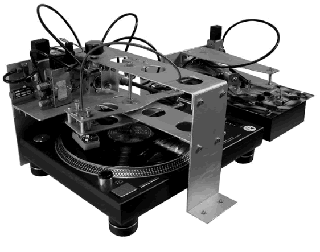
e-mail controlled scratch-robot

|

http://www.scratchrobot.com/

LITERAL:
This is an e-mail controlled scratch-robot.
Send an e-mail to robot@spess.com.
The robot will analyse your message and convert it into sound by scratching the disc. Within 24 hours you will be able to listen to your own audio e-mail.

Fuente: J.G

scrachrobot.gif