Transmediale 09: tagr.tv video on demand

|

tagr.tv will cover tm.09 with a team of ten people, offering daily video portraits of the exhibitions, lectures, performances and interviews with artists and other involved people.

tagr.tv
built a unique mobile interview environment, the tagr.tv umbr.ella, which is equipped with a bird-view camera and a microphone inside the umbrella. Besides the technical advantages, this setup provides the interview team with an own space – no matter where the interview takes place.

Since its foundation two years ago by students of the digital art class at the university of applied arts in Vienna, tagr.tv has grown into quite an archive of videos and other documentation of mostly European media arts festivals, and the works, artists and ideas presented, happening and evolving there.

Charla informativa EXGAE (Barcelona, ES)

|

Charla informativa sobre la situación legal de la comunidad DJ/VJ con respecto a los últimos acontecimientos y a la legislación relativa a la propiedad intelectual._*

*MARTES 3 DE FEBRERO 2009 – 20h
*C/ SANT PAU 58, BAJOS*
BARCELONA (Metro: Liceu)

*- Difundelo y convoca – *

La SGAE está intentando infundir el pánico en la comunidad de DJs, y VJs. Fomentando registros durante las sesiones. Invitando a la comunidad a charlas informativas , llenas de datos erróneos sobre temas de derechos de autor, de licencias, de multas por “piratería”, de derechos laborales etc etc.

*_Mucho de lo que están contando es falso y tendencioso._* Hay otras soluciones_!_

Por esto y a petición de muchos miembros de la comunidad, convocamos unacharla informativa (obviamente gratuita) en la sede de EXGAE (la primera asesoría jurídica especializada en proteger los ciudadanos de los abusos de las entidades de gestión, donde, con la ayuda de abogados especializados en derechos de autor y propiedad intelectual, explicaremos como está la situación y como hacerle frente, además de contrastar la información dada hasta ahora por la SGAE.

Todas/as los miembros de la comunidad están bienvenida/os, socias/os y no socias/os de entidades de gestión (el 30% de los miembros de EXGAE pertenece a alguna entidad de gestión, así que no hay suspicacia ;-)). Esta vez no están admitidos inspectores y detectives de la SGAE. Podremos hablar libremente.

Esta charla no se repetirá, así que pedimos a todas/os reenviar este mensaje a las personas interesadas lo antes posible, para que haya la máxima difusión. Cuanto mas personas sepan como hacerse respetar, menos podrán atacar la profesión/comunidad.

De momento ha habido relativamente pocos registros y creemos que si todo el mundo está bien informado sobre sus derechos, sobre los peligros reales y sobre como hacerles frente, la comunidad podrá encarar el problema airosamente y sin dejarse amedrentar.
Ahora mismo hay dificultades, es cierto, pero hay más opciones de las que se quiere hacer creer.

Audio Poverty (Berlin, DE)

|

Audio Poverty

February 6–8, 2009
Haus der Kulturen der Welt, Berlin

A weekend of Discussions and Lectures, Concerts and Parties, Performances and Experiments
Curators: Ekkehard Ehlers and Björn Gottstein

“Hungry musicians and pleasures gone haywire.” (DJ/Rupture)

Music is currently undergoing a loss of value not only in economic terms, but also in ways that have an impact on the social and aesthetic structure of musical life, affecting forms of publication, the culture of listening, musical discourse, and the music itself. Music has become a commodity, delivered from all parts of the world. Audio Poverty will explore the consequences of these changes: what is the relationship of the musician to the disappearing market? What is the significance of the individuation of listening for music’s social importance? What does it mean when the music critic is silent? And does musical poverty have a sound? Audio Poverty explores the link between music and poverty, from impoverished musical material to the starving artist. Audio Poverty crosses genres in both global and historical terms.

Audio Poverty looks at music from the margins—the sounds of the viola da gamba and a chirping Barbie doll, between broken vinyl and Africa’s acoustic everyday life, between Philippine art music and Detroit trash. The concert hall and the club are given equal status in a musical discourse where poverty becomes musically concrete.

The program thus includes such different formations as the arte povera of the avant-garde, Game Boy pop, folksy-Schumann interpretations by Josephine Foster, the style-crossing and transcontinental world music of the New York “bass visionary” DJ Rupture, the noise excesses of the US border crossers Hair Police, and the exuberant misappropriation of Birmingham’s Modified Toy Orchestra. Five musicians from Berlin, Vienna, and Innsbruck will undertake an extraordinary project, fasting and meditating for four days in a Buddhist cloister, then improvising together in a state of mental and physical emptiness. Audio Poverty will be accompanied by sound installations, performances, and DJ sets.

At the center point of the debates is confrontation: we have invited to the podium record label executives, journalists, academics, and musicians. Lobbyists face up to subculture. Musicology encounters World-Ghetto-Tech. DIY meets the diva. Lectures will be held on the loss of subculture, alternative aesthetic strategies, the culture of the Internet and blogs, musica povera and the dubious myth of the poor artist.

List of Participants:

Heinz-Klaus Metzger (G), Steve Goodman (UK), Kodwo Eshun (UK), Mark Chung (G), Gudrun Gut (G), Achim Bergmann (G), Jay Rutledge (G), Joel Berger (G), Christian Finkbeiner (G), DJ/Rupture (USA), Awesometapesfromafrica (USA), Ensemble Zwischentöne (G), Anna Lindal (S), Ensemble Asamisimasa (N), Ensemble Mosaik (G), Thomas Meadowcroft (AUS), Alan Hilario (FI), Oyvind Torvund (NOR), Sabine Sanio (G), Goodiepal (DK), Christine Lemke-Matwey (G), Helga de la Motte-Haber (G), Jonathan Fischer (G), Max Dax (G), Olaf Karnik (G), David Keenan (UK), Diedrich Diederichsen (G), Josephine Foster (USA), Kai Fagaschinski (G), Werner Dafeldecker (AT), Barbara Romen (AT), Eva Reiter (AT), Manon-Liu Winter (AT), Hair Police (USA), DJ Vamonos (UK), Alvin Curran (USA), Golo Föllmer (G), John Eden (G), Hartmut Möller (G), Orm Finnendahl (G), Serge Baghdassarians (G), Brian Duffy (UK), Gustav (AT), Sister Fa (G/SN), Christiane Rösinger (G), Modified Toy Orchestra (UK), Quarta 330 (JAP)

Transmediale 09: Exhibition, AMUNDSEN / I-landscape

|

AMUNDSEN / I-landscape
Jan-Peter E. R. Sonntag – de, 2003-2008

The interactive video and sound installation AMUNDSEN / I-landscape is part of Jan-Peter Sonntag´s series ‘almost cinema works’. The footage was taken in Norway close to the former house of Roald Amundsen (1872- 1928), the famous polar scientist. While watching the screen, the visitor is confronted with a psychoacoustic paradox, caused by sounds that can be experienced through headphones as well as a pedestal that generates deep sounds, which are absorbed by the viewer´s bodies.

[TM.09 exhibition : Survival and Utopia : Visions of Balance in Transformation]

Transmediale 09: Exhibition, Click & Glue

|

Click & Glue
Jana Linke – de, 2006/2007

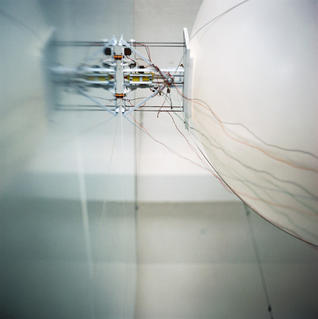
Click & Glue consists of four metal walls hanging from the ceiling that define a space in which a balloon filled with helium moves and floats through the air. The balloon is connected to a nylon thread and a mechanism that distributes glue. As the balloon continually moves, it touches the surrounding walls and leaves a small deposit of glue that functions as an anchor before the balloon continues its movement through the space. Thread by thread, the installation generates a web that eventually prevents the balloon from moving. In this way, Click & Glue becomes responsible for creating a network that locks itself in.

[TM.09 exhibition : 'Survival and Utopia : Visions of Balance in Transformation']

Transmediale 09 Exhibition: Sonic Antarctica

|

Sonic Antarctica
Andrea Polli – us, 2008

90degreessouth.org

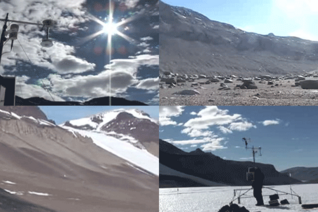
The Sonic Antarctica project is a radio broadcast, live performance and sound and visual installation featuring recordings of the Antarctic soundscape made during the author’s seven-week National Science Foundation residency in Antarctica during the 2007/2008 season. Sonic Antarctica features natural and industrial field recordings, geosonifications and audifications, interviews with weather and climate scientists and soundscape compositions. The areas recorded include: The Dry Valleys (77°30′S 163°00′E) on the shore of McMurdo Sound, 3500 km due south of New Zealand, the driest and largest relatively ice-free area on the continent completely devoid of terrestrial vegetation; and the geographic South Pole (90°00′S), the center of a featureless flat white expanse, on top of ice nearly nine miles thick. Sonic Antarctica has been produced as a full-length audio CD on the gruenrekorder label.

[TM.09 exhibition : 'Survival and Utopia : Visions of Balance in Transformation']

Transmediale Exhibition: Extreme Green Guerillas

|

Extreme Green Guerillas
Michiko Nitta – uk, 2007

We are forced to face the reality on a daily basis that environmental damage is more advanced than experts predicted. As global warming becomes the top of almost every government’s agenda, recent trends have put pressure on world leaders to act immediately: for instance, forced recycling, carbon offsetting and a 10-year campaign to make environmentally friendly living fashionable.

Are these efforts really improving the environment? Are these activities saving the Earth? What is eco-friendly living? When we live in a period where the worst climate disaster is about to happen, how can we live the ultimate green lifestyle?

egg008.jpg

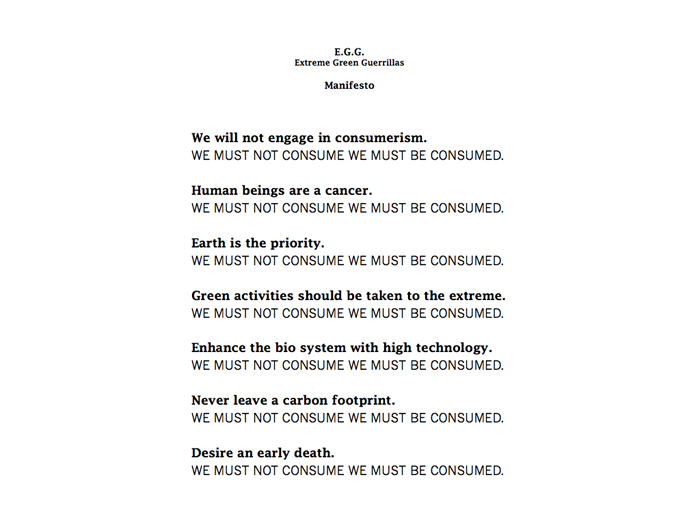
Nitta’s project takes current green trends to the extreme. The Extreme Green Guerillas are a network of amateur self-sustaining people who have shortened their lifespan through the ultimate green lifestyle. Whilst going to extreme lengths to protect the environment, they try to enjoy a decadent quality of life by re-using urban waste and biosystems, embracing emerging technologies in order to develop the ultimate green solution.

The Extreme Green Guerillas reject use of the corporation-controlled internet or CO2-producing postal services, instead preferring to send digital messages via migratory animals. By modifying urban vermin, such as pigeons and rats, they create edible and gourmet-like new delicacies. They attempt to solve overpopulation and resource problems through a ritualistic, premature death, administered via a euthanasing earring. The purpose of these individual, provocative gestures is to question the role of consumerism within green activities and to provoke questions regarding green lifestyles. The position the guerillas represent is realised through an ironic, playful and artistic use of creative, self-explanatory systems.

EGGs web

[TM.09 exhibition : 'Survival and Utopia : Visions of Balance in Transformation']

egg036.jpg

Institute for transacoustic research

|

transacoustic research mediateletipos

The institute for transacoustic research (german: institut für transakustische forschung, iftaf) was founded in 1998 to define and research transacoustics (german: transakustik). a crucial characteristic of transacoustic research is its interdisciplinary approach; it carries out science by means of art and art by means of science; methods and settings from both areas are combined to arrive at unique lines of connection and division.

Transacoustic research is concerned with the peripheral effects and tangential areas of acoustics, with their borders to other areas of research. these contours and definitional borders are necessarily blurred and vague.

The question of the essence of transacoustics/transakustik is as impossible to answer as the question of art or philosophy’s essence. the success, productivity and efficiency of transacoustic research do not depend on finding an answer to this question.

Transacoustics/transakustik as such, does not exist; there is only transacoustic research, which constantly circles its imaginary core and thereby arrives at the most diverse results and realizations.

Club Transmediale 09: Atak Night 4

|

Tras un par de días de programación nocturna orientada a la pista de baile en el Club Transmediale, ayer se celebró una de las noches que más expectación nos generaba. Fue la ‘Atak Night 4′, organizada por el sello japonés Atak, dirigido por Keiichiro Shibuya (recordamos Filmachine, instalación con que co-participó el año pasado en Transmediale, que nos impresiono un tanto).

Además de la actuación del propio Keiichiro, disfrutamos de otro contundente directo de Pan Sonic, ya clásicos para la gente con una oreja pegada a esto del ‘experimental’. También estuvo Evala, artista asociado a Atak aunque no tan conocido fuera de Japón (a partir de ahora le prestaremos atención a su sello Port Audio) y el gran Yasunao Tone, veterano artista japonés conocido por su implicación con el movimiento Fluxus y en el ámbito del arte sonoro por su trabajo desde los 80 con cds dañados, uno de los precursores de lo que se vino a llamar glitch en los 90s. En el CTM realizó una performance inmersiva con un sistema de sonido 7.1.

Aqui (y por orden de aparición) algunos pequeños fragmentos de video documentando esta magnifica noche:


(more…)

Club Transmediale 09: Conference

|

Seguimos estos días de visita por Berlin, asistiendo a la programación del Club Transmediale, a la que se sumará la de la Transmediale en sí, que arranca en unas horas. Una de las novedades del CTM este año es la extensión de su programación diurna, que incluye este año una nutrida serie de conferencias, paneles y proyecciones bajo el tema de esta edición: ‘STRUCTURES – Backing-up Independent Audio-visual Cultures’.

En estas jornadas se examinan toda una serie de aspectos relativos al estado actual de las pequeñas inciativas, redes y escenas independientes musicales, los cambios en curso en los modos de distribución, consumo y apreciación musical, el potencial socio-cultural y político de las culturas musicales y su papel como agente de cambio, etc. Se está hablando de temas como la tan cacareada crisis de la industria musical, las licencias libres, las implicaciones de la incipiente digitalización de la música y los cambios de soporte, las redes p2p, los mp3 blogs, los pequeños sellos y tiendas especializadas, las escenas musicales no-profesionales, el activismo sonoro y las relaciones entre política y música, etc etc.

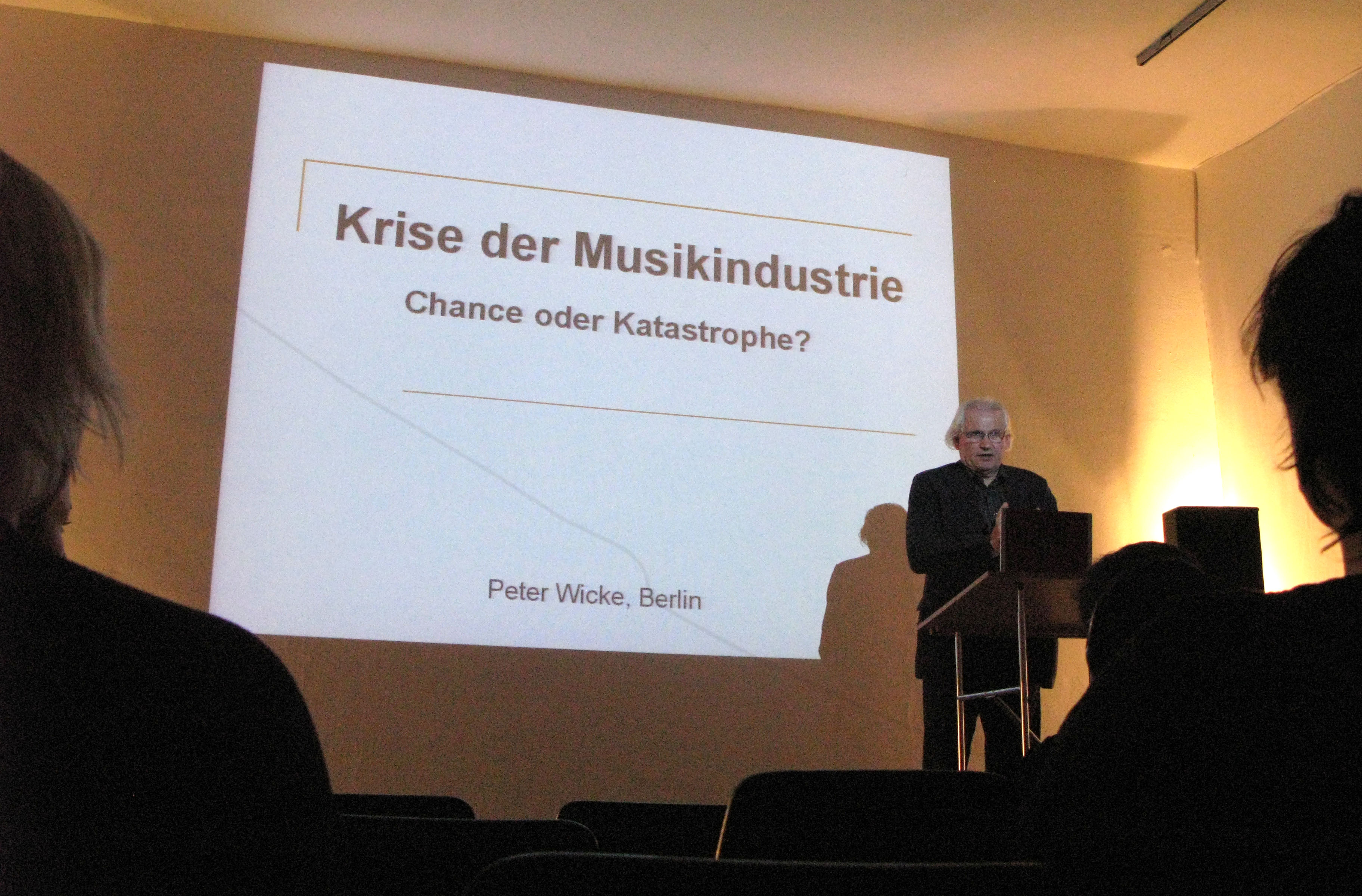
El sábado fue el día de introducción, y arrancó con la participación del musicólogo Peter Wicke. Su keynote, titulado ‘la crisis de la industria musical: ¿oportunidad o calamidad?’, tuvo un corte bastante técnico y se propuso analizar la progresión en los ultimos años de la industria musical a nivel general, analizando el papel de la red en los cambios observados, aunque no entró tanto en ilustrar otros modelos alternativos de negocio o el papel de las licencias libres. Wicke subrayo que el valor económico o las cifras de ventas no son análogas al consumo ‘real’ o el valor cultural de los productos y aportó datos como que estadísticamete la gente que más música descarga de internet es también la que más música compra y más involucrada está en la cultura musical (creo que bastante obvio creo para much@s pero en lo que puede que sea necesario incidir). También apuntó la transformación progresiva del valor cultural asociado a la música así como en la percepción de los símbolos relacionados con la cultura musical, con el paso del ‘branding’, la mitificación de los artistas y la figura del consumidor pasivo hacia modelos más participativos e interactivos. Su conclusión fue eso que ya muchos venimos opinando desde hace tiempo, y es que la tan alarmante (según nos quieren hacer creer muchos interesados) crisis de la industria musical a causa de la red es tan solo la crisis de un modelo muy específico de negocio y en absoluto no una crisis cultural.
(more…)