Medium Religion

Das Medium Religion (Religion as Medium), 2006

ZKM | Center for Art and Media Karlsruhe
23-11-2008 / 19-04-2009

Today’s religious movements operate predominantly with images that can be spread across the entire world in a flash by means of contemporary mass media. The electronic picture media video and television have become the chosen media for religious propaganda as they are capable of being produced and distributed especially fast. The “return of religions” that people are currently talking about does not necessarily mean that more people have become religious nowadays. Instead, religions have moved from the private sphere of personal belief out into the public sphere of visual communication. In this, religions function, for one, as machines for the repetition and mass medial distribution of mechanically produced images.

For another, the role model for this repetition is found in the repeatability of religious rituals, which is the foundation for the emergence of all subsequent medial reproduction technologies. The original media used by religions were scriptures and books, assigned the same task of distributing belief. Text served, additionally, to canonize belief. Without writing there is no church; without scrolls, no belief. Thus, right from the start, through the demand for repeatability embodied by the ritual, religion was not only bound to media, but was itself a medium: religion as medium complements media as religion.

The exhibition “Medium Religion” aims at demonstrating this medial aspect of religion using current examples of religious video propaganda and the work of contemporary artists. The horizons of religion have expanded enormously through the development of electronic media. The uncomplicated recording of the message (e.g., the video message), the rapid distribution, and huge, nearly global scope (e.g., television, Internet), offered a technological base for religions’ reentry into public awareness. Since the mass media constitute public awareness and religion makes use of mass media (e.g., the broadcast of the Papal mass from Rome), it is only logical that it, too, will shift more into public awareness. The result is the reevaluation of minority faiths and their messages.

[+info]

Technocalyps (documentary)

Technocalyps
A three-part documentary by Frank Theys

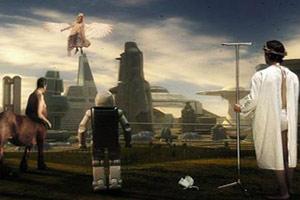
Technocalyps is an intriguing three-part documentary on the notion of transhumanism by Belgian visual artist and filmmaker Frank Theys. The latest findings in genetics, robotics, artificial intelligence, bionics and nanotechnology appear in the media every day, but with no analysis of their common aim: that of exceeding human limitations. The director conducts his enquiry into the scientific, ethical and metaphysical dimensions of technological development. The film includes interviews by top experts and thinkers on the subject worldwide, including Marvin Minsky, Terence McKenna, Hans Moravec, Bruce Sterling, Robert Anton Wilson, Richard Seed, Margareth Wertheim, Kirkpatrick Sale, Ralph C. Merkle, Mark Pesce, Ray Kurzweil, Rabbi Youssouf Kazen, Rael and many others.

Part 1: Transhuman
Part 1 gives an overview of recent technological developments (biogenetics, artificial intelligence, robotics, implants, nanotechnology,…) and prognoses made by leading scientists about the impact of these developments in the near future.

Part 2: Preparing for the Singularity
In this part advocates and opponents of a transhuman future are weighed against each other; prognoses are done when we can expect the transhuman revolution and how people are preparing for it already now.

Part 3: The Metaphysics of Technology
This part covers the metaphysical consequences of the new technological revolution. On the one hand scientist start to use metaphysical concepts to describe the impact of their research, on the other hand, a surprisingly large number of scientific projects is inspired by religious aspirations and more and more theologians from any religious or spiritual belief are getting interested in these aspirations of new technology, making the discussion inextricable complex.

miniphp.jpeg

Babble

Babble es un sistema para crear poesía sonora automática, inspirado en el uso de vocablos para describir sonidos musicales, jugando en el espacio entre el discurso y la percepción sonora.

Sound poetry is poetry free from the usual contraints of syntax and semantics, where only the sounds of words are used to form the structure and feel of the poem. The Ursonate by Kurt Schwitters is one fine example.

Vocable words are used by musicians to describe the sounds their instruments make, while teaching, swapping tunes and during performance. In many cultures formal systems of vocable words have developed, including the bol syllables of the Indian tabla drums, and the canntaireachd of the Highland bagpipes.

Comparitative research into the perception of sound and speech has found both differences and correspondences. That there are two conflicting modes of perception is made clear by the phenomenon of sine wave speech. On the other hand scientific research such as that carried out by Aniruddh Patel shows correlations between the rhythm of music and speech in different cultures, as well as between neurological activations of the listeners of music and speech.

Babble sits on the boundary between speech and music, allowing play with the structure and form of simplified phonetics without having our perception hijacked by speech processing.

Under the hood is a physical model of a guitar string (Karplus-Strong synthesis), and a formant filter to produce vowel-like sounds. The different consonants control the excitation and noisiness of the string, and the vowels control the tuning and the formant filter. The result is something like a speech synthesiser, but with the vocal apparatus largely replaced with a single guitar string.

Although babble’s phonetic system is quite unlike that of English or any natural language, when faced with the text that generates the sound, as well as the vowel-like queues, the listener has the sensation of ‘hearing’ speech as the brain searches for meaning.

Babble is by Alex McLean and is written in the open source HaXe language, which compiles to javascript and flash. The source code is available under the GNU Public License version 3 or later.

Piksel08 :: Code Dreams [Bergen, Noruega]

Piksel08 :: festival
diciembre 4-7 2008

Piksel08 :: exposición
12 diciembre 08 - 25 enero 09

¿Cómo sueña el código? ¿Cuáles son los sueños del código?

Piksel08 examina el otro lado del código, una visión alternativa a una realidad establecida de trabajo y juego. El hardware abierto y el software libre proyectan una visión utópica, pero real dentro de las economías del capital; la fábrica de sueños de la tecnología establecida.

Dentro del encuentro fortuito sobre una mesa de disección de una máquina de coser y un paraguas, el hardware y el software se aplastan.

Piksel08: code dreams explora los sueños de esta máquina abierta; licenciados programando por placer, construcciones paranoicas de ingeniería inversa, prácticas de programación automáticas, hardware flexible y magia cotidiana.

[+info]

Sound and Healing

Sound and Healing

A call for resources for Radio Broadcast.

Sound and Healing is a triangulation between artists, practitioners and researchers focusing on healing and sound. How do artists create from a healthy place or access healing energy, ideas and sounds while creating their sonic art? What are the healing modalities currently being practiced around the globe where sound is a primary vehicle for positive change, health and wholeness? What research studies and resources of these uses of sound exist and what are the implications? How is sound changing the world… serving as a vehicle for healing, and an evolving humanity? These questions and more will be explored in a series of programs created for radio, distributed globally through the digital and analog means.

The Mexican Centre for Music and Sonic Arts (www.cmmas.org) will be promoting the
production of a series of 1 hour programs about this interesting and seldom addressed topic of sound and healing. Composer Paul Rudy will be gathering music, materials, views and experiences from artists, practitioners, and researchers, to create the series of shows that will be broadcast in Mexico and other countries and will be available online at www.cmmas.org

Materials ranging from audio tracks, personal anecdotes and experiences, citations, articles, names of artists/practitioners/researchers, papers, or anything else related to sound and healing are being solicited. Please email materials to paul@cmmas.org (music be can be emailed as mp3’s or sent directly to Paul Rudy along with other materials such as review copies of books and articles). These programs are about conversations from all view points, so please do not hesitate to send anything even tangentially related to sound and healing. Submission will serve as consent for materials to be used for broadcast. All material used will be given due credit or citation.

Deadline: February 1, 2009

Address for CD’s and Materials
Paul Rudy
1317 E. 97th Terrace
Kansas City, MO 64131
USA

estudio_composicion.jpg

EE UU podrá realizar entrenamientos con sónar

Noticia en El País

Literal:
EE UU podrá realizar entrenamientos con sónar en California a pesar de las ballenas
El Supremo desestima la decisión de un juez federal que obligaba a la Marina “a tomar precauciones” porque la legislación protege a los mamíferos acuáticos de la zona

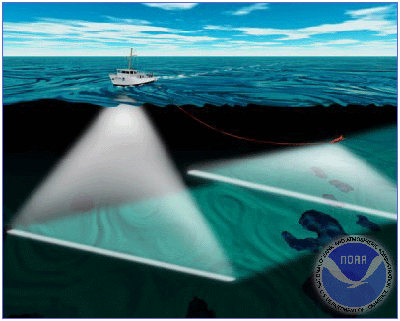
El Tribunal Supremo de Estados Unidos ha dictaminado hoy que la Armada podrá llevar a cabo ejercicios de entrenamiento con sónar en la costa del sur de California sin tener en cuenta la legislación para proteger a las ballenas, delfines y otros mamíferos acuáticos de la zona.

El Tribunal desestima así la decisión de un juez federal que obligaba a la Marina “a tomar precauciones” durante los ejercicios navales que la Armada comenzó en febrero de 2007 en el litoral californiano y que está previsto que finalicen en enero de 2009.

Entonces, grupos ecologistas interpusieron una demanda argumentando que las maniobras de los buques y submarinos militares resultan peligrosas para 37 especies marinas, entre ellas la ballena azul (en serio peligro de extinción). A su juicio, las ondas emitidas por las naves afectan a la capacidad de los animales para comunicarse entre sí e incluso para navegar, causando la muerte de gran cantidad de ellos.

Seguir leyendo…

sonar.gif

¿Cómo sonaría esto en el espacio?

Al parecer, en Marte el sonido no viaja muy rápido, sus propiedades físicas son las mismas que en la Tierra, obviamente, pero según una simulación realizada recientemente, allí el sonido tiene un tono más bajo y un alcance más corto.

El tono más grave se debe a que la atmósfera del planeta rojo está formada sobre todo por dióxido de carbono, con pequeños porcentajes de nitrógeno y argón y trazas de vapor de agua y oxígeno.

Según Amanda Hanford, una de las investigadoras al cargo de las pruebas, “cuando respiras de un globo de helio y hablas, tu voz se escucha más aguda. Suponiendo que pudiésemos respirar dióxido de carbono (que es muy tóxico), tu voz se escucharía más grave”

La distancia a la que puede viajar el sonido también se ve afectada por esos cambios atmosféricos. Al haber una presión más baja, el sonido no llega tan lejos. La teoría sugiere que un grito humano en la Tierra puede viajar poco más de un kilómetro antes de ser absorbido por la atmósfera. En Marte, el mismo grito se movería como mucho 15 metros.

Hay otros científicos que se han preguntado cómo sonaría la música en otros planetas. Tim Leighton, un profesor de acústica de la Universidad de Southampton, subraya que “todas las sondas que se han lanzado para explorar el sistema solar eran capaces de ver a través de cámaras… pero eran sordas. No estaban equipadas con micrófonos”.

El último intento de grabar sonido en Marte lo llevó a cabo la NASA, pero se perdió la comunicación con la sonda espacial, que llevaba un micrófono en miniatura, antes de entrar en la atmósfera del planeta.

Podéis encontrar más información en estos dos artículos:
Can you hear me now? Not on Mars
Ever Heard Bach, On Mars?

Huasco Songs

HUASCO SONGS is an art project based on a travel in Valle Huasco, Chile, in January 2007, by Stian Skagen, Gerardo Gonzales and Erikk McKenzie.

The videos on the site are a compilation of some of the sounds and images we recorded, mixed with recordings from an anti-Pascua Lama demonstration in Santiago the 21th of December 2006. Well, to make it short: All these impressions of another stupid human exploit of natural resources - putting water at risk in one of the driest regions on the planet - inspired us to create a performance together. It was performed in the Theaterschool Amsterdam and in La Poderosa, Barcelona, during May 2007.

We hope that through our creative work more people will get to know the situation in Valle Huasco, so that the clean water will keep flowing through the valley for as long as plants, animals and humans will need it to survive. AGUA VALE MAS QUE ORO.

Thanks to all the people we have met on our journeys, especially to Margarita & Papo, to Marcela & to all the powerful loving people we met in Arco Iris, Conay.

more info at: www.noapascualama.org

AlJazeera English: The environmental cost of Chile’s gold mines - 08 Jul 07

Processing 1.0

Processing 1.0 ya está disponible desde hoy mismo. Tras más de 150 versiones beta desde su nacimiento alla por el 2001 y una imparable actividad y expansión desde entonces, este ya hiperconocido entorno de programación opensource dedicado a la creación visual e interactiva ha lanzado su versión oficial.

processing.org incluye tutoriales, un showcase de trabajos realizados con este lenguaje, entrevistas, foro de usuarios, montones de ejemplos, y toda la info relacionada con este lenguaje.

En castellano tenemos la comunidad de usuarios visualp5.net.

Today, on November 24, 2008, we launch the 1.0 version of the Processing software. Processing is a programming language, development environment, and online community that since 2001 has promoted software literacy within the visual arts. Initially created to serve as a software sketchbook and to teach fundamentals of computer programming within a visual context, Processing quickly developed into a tool for creating finished professional work as well.

Processing is a free, open source alternative to proprietary software tools with expensive licenses, making it accessible to schools and individual students. Its open source status encourages the community participation and collaboration that is vital to Processing’s growth. Contributors share programs, contribute code, answer questions in the discussion forum, and build libraries to extend the possibilities of the software. The Processing community has written over seventy libraries to facilitate computer vision, data visualization, music, networking, and electronics.

Students at hundreds of schools around the world use Processing for classes ranging from middle school math education to undergraduate programming courses to graduate fine arts studios.

The Processing software runs on the Mac, Windows, and GNU/Linux platforms. With the click of a button, it exports applets for the Web or standalone applications for Mac, Windows, and GNU/Linux. Graphics from Processing programs may also be exported as PDF, DXF, or TIFF files and many other file formats. Future Processing releases will focus on faster 3D graphics, better video playback and capture, and enhancing the development environment. Some experimental versions of Processing have been adapted to other languages such as JavaScript, ActionScript, Ruby, Python, and Scala; other adaptations bring Processing to platforms like the OpenMoko, iPhone, and OLPC XO-1.

Processing was founded by Ben Fry and Casey Reas in 2001 while both were John Maeda’s students at the MIT Media Lab. Further development has taken place at the Interaction Design Institute Ivrea, Carnegie Mellon University, and the UCLA, where Reas is chair of the Department of Design | Media Arts. Miami University, Oblong Industries, and the Rockefeller Foundation have generously contributed funding to the project.

The Cooper-Hewitt National Design Museum (a Smithsonian Institution) included Processing in its National Design Triennial. Works created with Processing were featured prominently in the Design and the Elastic Mind show at the Museum of Modern Art. Numerous design magazines, including Print, Eye, and Creativity, have highlighted the software.

For their work on Processing, Fry and Reas received the 2008 Muriel Cooper Prize from the Design Management Institute. The Processing community was awarded the 2005 Prix Ars Electronica Golden Nica award and the 2005 Interactive Design Prize from the Tokyo Type Director’s Club.

processing.jpg

LiGHTSCOOP (Plaza Futura, Eindhoven)

LiGHTSCOOP is an interactive Light Installation, created with LED and multiple sensory devices. By use of infra-red and led-technology, the passenger is capable to ‘enlighten’ and ‘reveal’ the laser etchings on the glass to create a trace of light over time. Lightscoop exist of 13 plexiglass panes, one for each step on the stairs. When no activity, Lightscoop is almost transparent, adapting to its environmental aesthetics of the architecture. The light and colors transforms graduadly in different shades, to continually enhance a new sense and mood.

Lightscoop is a project by Olga Mink and Roel Verlinden. The installation is created for PlazaPlus festival, and is exhibited until january 2009.

Engineering by: Didier
Sound: Scanner
Thanks to Marius Watz and Plaza Futura.

Lightscoop interactive installation from Olga Mink on Vimeo.

elruido.com

En elruido.com es un Sitio, patrocinado entre otros por Proceso Digital de Audio, en el cual se pretende dar cabida a contenidos específicos de acústica física, fisiológica, ingeniería acústica y procesado de señal, así como la divulgación de los efectos del ruido dando cabida a proyectos de control y gestión del ruido.

Aunque el desarrollo de un sitio Web no acaba nunca y en este especialmente, actualmente nos encontramos en construcción y pedimos la colaboración de todo aquel que crea que tiene algo que aportar.

Consultoría Jurídica

Contacto

ecoreses.jpg

Hot nanotube sheets produce music on demand

http://www.newscientist.com/article/dn15098
http://www.xataka.com/2008/11/04-nanotubos-para-altavoces-delgadisimos

Literal (newscientist):

Sheets made of carbon nanotubes behave like a loudspeaker when zapped with a varying electric current, say Chinese researchers. The discovery could lead to new generation of cheap, flat speakers.

Since the early 1990s, nanotubes have been intensively studied by researchers across the globe. The tiny structures are widely touted as potential drug delivery devices but might also be useful in more exotic gadgets including artificial photosynthesis devices and space elevatorsMovie Camera. But no one has thought to test their acoustic properties until now.

Shoushan Fan and his research team at Tsinghua University in Beijing, China, working with colleagues at Beijing Normal University, created a thin sheet by roughly aligning many 10-nanometer-diameter carbon nanotubes. When they sent an audio frequency current through the sheet, they discovered it acted as a loudspeaker.

Literal (Xataka):

Imagina poder tener un altavoz o sistema de sonido literalmente pegado a un gadget o incluso un televisor. Como si de una pegatina se tratara. Es lo que podría conseguirse con los nanotubos de carbono, ese material que parece llegado del futuro para solucionar la mayoría de males de la electrónica de consumo en particular y la tecnología en general.

Aunque los nanotubos de carbono se estudian desde hace casi 20 años, hasta ahora no se habían buscado sus propiedades acústicas, que ahora ha quedado demostrado que pueden desarrollar sin problemas. Lo han hecho Shoushan Fan y su equipo de trabajo de la Universidad de Tsinghua en Pekín.

Este equipo ha logrado crear una superficie que podemos acoplar a un gadget y que está compuesta por nanotubos enrollados con un diámetro de 10 nanómetros (nosotros no notaríamos que son en realidad tubos sino una superficie completamente plana) que al aplicarles una frecuencia audible, hacen que actúen como altavoces. Casi magia para nuestros ojos.

La base del funcionamiento de estos nanotubos de carbono como altavoces debemos buscarla en la diferencia de temperatura que ese material puede alcanzar respecto al ambiente cuando aplicamos una señal de sonido. Esa diferencia de temperatura provoca cambios en la presión del aire que rodea la superficie recubierta de nanotubos y se produce el sonido.

Ciclo de conferencias “Aspectos del arte sonoro” (Barcelona)

Aspectos del arte sonoro

El propósito de este ciclo de conferencias es propiciar el conocimiento de algunas de las manifestaciones creativas que han ido configurando lo que hoy llamamos arte sonoro. Una disciplina cuyo controvertido debate denominativo no ha empañado el importante auge que ha experimentado a lo largo de las últimas décadas. Surge a principios del siglo XX con la eclosión del movimiento futurista italiano y las primeras vanguardias musicales, y su evolución posterior transcurrirá pareja a la de un incesante desarrollo de la tecnología electrónica. Su naturaleza híbrida y a menudo compleja delimitación conceptual no han sido, sin embargo, obstáculo para la efectiva emergencia de una serie de planteamientos estéticos que comparten una voluntad primordial: el empleo artístico del sonido. En consecuencia, son cada día más los artistas y compositores que invierten su imaginación en diversas actividades que proponen verdaderas reflexiones acerca de nuestra escucha. Y precisamente esas actividades y su contextualización histórica serán objeto de análisis a lo largo de estas seis charlas.

- Carmen Pardo: “En los orígenes del arte sonoro” (25/11/08 de 17:00 a 18:30)
- José Manuel Berenguer: “La música en el tiempo de la electricidad” (01/12/08 de 17:00 a 18:30)
- Carlos Gómez: “De la escultura a la instalación sonora: Más que tridimensional” (04/12/08 de 17:00 a 18:30)
- Eduard Escoffet: “La poesía sonora desde sus orígenes (1952-2008)” (09/12/08 de 17:00 a 18:30)
- Ferran Cuadras: “Paisaje sonoro y ecología acústica: El rumor de Vancouver” (11/12/08 de 17:00 a 18:30)
- José Iges: “Arte radiofónico: Arte sonoro para el espacio electrónico del a radio” (17/12/08 de 17:00 a 18:30)

Las conferencias tendrán lugar en:

Espacio Movistar
Campus de la Diagonal / Portal del Conocimiento
C/ Pascual i Vila s/n
08028 Barcelona
t. 93 490 77 31

snd96-2.jpg

Javascript drum machine

http://www.themaninblue.com/experiment/JS-909/

js-909

[Cameron Adams] recently appeared on a panel about JavaScript libraries. He represented the hard working coder that still wrote everything from scratch. He wanted to make something mindblowing for the audience. He ended up creating the JS-909 drum machine entirely in javascript without relying on libraries or flash. While he makes no claims of compatibility, it certainly is a nice bit of kit.

js-9.jpg

Via2: Hack a Day by Eliot Phillips
Via: opaco

IMAGINE… NO COPYRIGHT, de Joost Smiers y Marieke Van Schijndel

lugar: Medialab-Prado. Plaza de las Letras, C/ Alameda, 15 · Madrid

Presentación del libro Imagine… No copyright, de Joost Smiers y Marieke Van Schijndel. El libro defiende la configuración de una nueva situación de igualdad de condiciones, un mercado sin copyright y sin el dominio de un reducido número de corporaciones culturales en el que puedan prosperar nuevas formas libres de expresión artística. Presentación a cargo de Javier de la Cueva y Enrique Bustamante.

Joost Smiers es también autor de Un mundo sin copyright, un libro polémico que plantea una crítica radical sobre los mecanismos mediante los cuales la industria cultural controla los medios de producción, distribución y promoción de la creación artística. Un mundo sin copyright se presentó en el medialab de Conde Duque el 6 de febrero de 2007, con la presencia de Javier Candeira y Antonio Lafuente.

[+info presentación]
[+info libro]