Sonic Acts XIII: Fred Worden

|

Nuetro primer contacto a la llegada a Sonic Acts fue con la película 1859 de Fred Worden, una obra de 30 planos construída cuando el LSD era ilegal. La proyección sirvió como antesala lisérgica a la programación del viernes centrada en el audiovisual. Fred Worden citó el trabajo de Bruce McClure como introducción a su conferencia After hours in the cerebral kitchen. Esta charla fue una explicación básica de el complejo trabajo que necesita una película como la exhibida. Según él, el ingrediente secreto para todos sus films, es la parte negra que queda entre imagen e imagen, a partir de lo cual puede enlazar estas proyecciones con conceptos como la ilusión Phi, basado en teorías gestálticas de Maas Wertheimer.

Es precisamente en la oscuridad que sigue a la imagen, cuando los mundos colisionan (WHEN WORLDS COLLIDE, película proyectada tras la charla), creando el sentido propio de estas películas. Un sentido que se basa en el materila mismo de la película, y que F.Worden ha mantenido incluso al pasar del celuloide al DV en 2004.

El título de la película podría hacer referencia al libro de Philip Wylie y Edwin Balmer escrito en 1933 y su adapatación homónima al cine de 1951 When Worlds Collide. La diferencia, es que mientras las versiones de ciencia ficción hablaban sobre choques interplanetarios, estas hablan de choques de imágenes. En cualquier caso, es a partir de estas colisiones desde donde se produce el sentido e incluso el argumento.
(more…)

Sonic Acts XIII: The Auscultations of Seven Connor

|

“Writing about music is like dancing about architecture”.
A quote whose certain source remains unknown while attributed to people such as Miles Davis, Elvis Costello, or Frank Zappa among others. I think I found it firstly through the tireless re-mediator Paul D. Miller (a.k.a. Dj Spooky).

It amusingly illustrates the contradictions often inherent to some critical and intellectual discourses on experiential and sensual matters, which sometimes might reveal as rather pointless or simply boring. It came back to my mind while sipping fastly a coffee in the hall of De Balie in reply to a friend heading out the conference hall who joked about the difficulties and confusion that talking ‘too much’ about sound might lead to.

The panel titled ‘The Hot Space in Music‘ was still taking place and we had just listened a while ago to the intervention of Steven Connor, who introduced that session. His name was unknown to my ears before the festival and actually resulted in another of the inspiring discoveries of this edition. Although his lecture: ‘Auscultations (Listening In) consisted in a nonstop discourse full of thoughts and words (no powerpoints, no actual audio examples, just his text, voice and gestuality) definitely it was not boring or pointless at all, but a rather poetic reflection on sound and listening.

Author of books about Joyce, Beckett, ventriloquism, skin or flies and currently preparing a book about the historical poetics of air, his presence in the program drew our attention and curiosity, making us remain in the Conference even though if the plan that afternoon was finally visiting the exhibition (the full schedule of the festival was making of it a difficult task to fulfill in the weekend).

He talked about the locus of listening, its nuances and the space(s) of sound and music, elaborating on those through tinnitus and other topics. Both dense and eloquent, it was inspiring to listen to this talk, which actually I hope to re-listen to soon. A visit to Steven´s site confirmed him as an accomplished orator, cultural critic and a prolific writer with an archive full of talks, writings and broadcasts ranging a variety of topics, many of them available as texts and in audio too. Specially interesting for us the ones classified under: ‘Seeing to Sound: On Sound, Music and Voice‘.

sound is unthinkable without space…
sound is always more than space…
sound and space never exactly coincide…
sound and space are consustantial but never exactly coexistant…

I am outisde the sound which is at the same time inside me…

music rarely happens in space, because music IS space.

SAXIII: Anthony McCall: Line Describing a Cone

|

Line Describing a Cone
Anthony McCall
Deep Spaces | Fri 25th Feb 2010 | Paradiso, Amsterdam

Reading the program of Sonic Acts I got intrigued about this 30min, B&W, silent film. Made in 1973, it is the first of McCall´s ‘solid light’ film series, an exploration on the sculptural qualities of light, using simple 16mm projections. He developed these series until the late 70s, only re-starting this practice more than twenty years later, this time using digital tools. This film is now a legendary example within the field of expanded cinema.

In McCall´s words: ‘The viewer watches the film by standing with his, or her, back towards what would normally be the screen, and looking along the beam towards the projector itself. The film beings as a coherent line of light, like a laser beam, adn develops through its 30-minute duration into a complete, hollow cone of light.’

That´s what we could see in the small hall of Paradiso, a dot describing a line, slowly becoming a physical conical volume. A minimal and elegant cinematic sculpture which turned also into a playful experience for the audience, who was quite amused interacting with the emerging light volume.

After experienced the film, I am now looking forward to catch up any of McCall´s new light installations.

Check also:

http://www.anthonymccall.com/

VIDEO: A ‘solid-light’ film by Anthony McCall
March 2007, Tate Modern, UK

Anthony McCall: The Solid Light Films and Related Works. Northwestern Univ. Press. 2005

Sonic Acts XIII: Barry Truax

|

Barry Truax opened the session at De Balie on Saturday, a whole day devoted specially to soundscape, phonography and the exploration of the acoustic qualities of our environment.

Truax´s career has been combining academic computer and electroacoustic music with social and ecological concerns. Since the 70s, as part of the World Soundscape Project and at the Simon Fraser University in Vancouver, he has been developing academic and artistically the fields of music composition with environmental sounds and acoustic ecology.

His compositions explore the field between two extremes of the world: the micro structure and inner complexities of sound itself and the external world of complexity present in the soundscape. Drawing upon elements taken from the world we live in, combining computer tools such as convolution or granulation and multichannel diffusion techniques, his compositions aim to immerse the listener into sonic journeys and imaginary narratives, suggesting moments of profound listening.

The keynote at Sonic Acts contained instructive examples of his compositions, which are extensively documented, partly available online and compiled in two published dvd-roms. We learned about the narratives and compositional techniques underlying works such as PendlerdrØm, Island, Basilica, Temple and The Shaman Ascending, listening to sound examples of the original and processed materials aswell as to excerpts of the compositions in a nice multichannel setup.

Barry also presented Chalice Well, one of his latest works, which we will listen to later in Paradiso, as part of the Acoustic Spaces evening.

Video of another lecture of Barry Truax a few months ago at The Vancouver Computer Music Meetings (VCMM).

Truax´s Handbook for Acoustic Ecology

Sonic Acts XIII: Expanded Space Viernes 26

|

mediateletipos sonic acts optical machine

El viernes tras una intensa sesión de conferencias, de las que de primeras cabe destacar Derrick de Kerckhove o Christopher Salter, la jornada de la tarde en Paradiso estuvo centrada en una programación audiovisual presentada con un claro giro a la analógico, primitivista, en el que primaba a la manipulación directa del material que produce las sombras y los sonidos, todo ello debidamente amplificado.

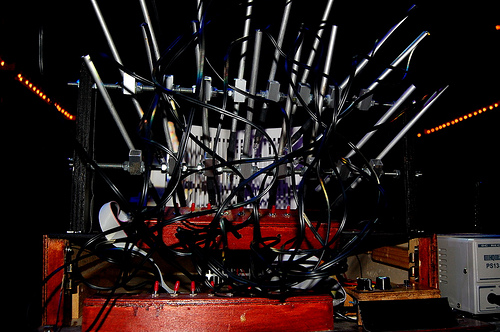
La intensidad de algunas actuaciones, no hacía más que restar protagonismo a otras, por lo que sin animo de cualificar, aquí dejo las actuaciones más reseñables. Comenzando con Optical Machines (SHIFT) proyecto formado por Maarten Halmans como músico y Rikkert Brok manipulando su máquina de luces y sombras. Brok crea máquinas para proyecciones en directo, como podréis ver en su página, que bajo su pobre apariencia, generan un espectáculo redondo.

Tras ello Takashi Ito con Spacy fue, en mi opinión, el ejemplo más ilustrativo para entender muchos de los discursos teóricos y artísticos presentados en el festival. La obra exponía una concepción del espacio a partir de las peculiaridades de la representación cinematográfica, introduciéndose una y otra vez en planos y más planos y generando un espacio retranqueado sobre si mismo. Un acercamiento engañoso entre marcos.
(more…)

Sonic Acts XIII: Conferencia

|

debalie-ams

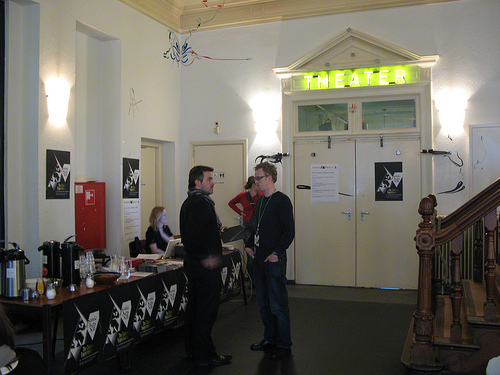
La conferencia internacional de Sonic Acts la acoge De Balie, un teatro-cine activo como centro de debate en torno a temas culturales y políticos. En ella se presenta un intensivo programa de casi ocho horas durante cada uno de los tres días de mayor actividad del festival.

El viernes 26 el programa se abrirá con un keynote de Derrick de Kerckhove titulado Beyond Perspective, From the Point of View to the Point of Being, seguido de cuatro sesiones más. En Architectures of Sound, Daniel Teruggi (director del GRM francés) y Raviv Ganchrow (profesor en el Instituto de Sonología de La Haya) hablarán de diversas formas de transformación del espacio mediante sonido. Naut Humon (de Recombinant Media Labs) y el artista-investigador Christopher Salter, analizarán los mecanismos de inmersión que operan en la audiencia en los espectáculos audiovisuales surround. Utopian Spectacles repasará hitos históricos como los legendarios Vortex Concerts de finales de los 50s y parte del trabajo de John Cage, incluyendo la presencia de Robert Whitman, uno de los pioneros en la combinación de teatro y tecnología. Y para terminar la jornada, una sesión dedicada a las poéticas del espacio híbrido, prestando atención al uso de tecnología para extender e intervenir nuestras experiencias cotidianas y el espacio público.

El sábado está especialmente dedicado a la exploración y manipulación acústica del mundo que habitamos, con la participación de nombres ya clásicos en el campo de la composición con paisajes sonoros como Barry Truax, Hildegard Westerkamp o Annea Lockwood. También intervendrá el cineasta Fred Worden, habrá una sección titulada Invisible Architectures, con la presencia del ‘trans-arquitecto’ Marcos Novak y un panel organizado por STEIM donde se hablará de manipulaciones del espacio sonoro-musical.

La jornada de cierrre se abrirá con un keynote de Michael J. Morgan, autor de The Space Between Our Ears (2003), que hablará de cómo funcionan los mecanismos humanos de percepción y accion espacial. Le seguirán las presentaciones de los artistas Jan-Peter E.R. Sonntag, H.C. Gilje y Jacob Kirkegaard. Y para cerrar, la novena sesión de la conferencia, Gardeners of the Future, estará dedicada a nuevas aproximaciones tecnológicas a la naturaleza, la genética y la biología desde el prisma de la posible integración de la ciencia en el arte.

Sonic Acts XIII: The Poetics of Space

|

Mañana jueves arrranca Sonic Acts XIII, uno de los festivales europeos más interesantes, que desde 1994 se ha dedicado a explorar las conexiones entre arte, tecnología, música y ciencia, ofreciendo en cada edición una amplia programacion en torno a un tema escogido. El festival combina un programa de conferencias con una exhibición, conciertos, proyecciones y live performances en distintas localizaciones de Amsterdam.

Esta edición toma su nombre prestado de la traducción inglesa del libro La Poétique de l’Espace, publicado en 1958 por el filósofo francés Gaston Bachelard y está dedicada a la investigación del concepto de espacialidad en una serie de prácticas artisticas que abarcan el arte audiovisual, el cine, la música y la arquitectura, las cuales exploran el espacio de diversas maneras.

En Mediateletipos publicamos nuestra pequeña crónica de la pasada edición en 2008, dedicada a la experiencia cinemática. Esta vez seremos dos los visitantes teletiperos, Jose Luis Espejo y yo mismo (Pablo al aparato), quienes estaremos bloggeando en colaboración con la organización del festival y empapándonos de lo que por allí suene. Así que a partir de hoy aparecerán varios posts dedicados a Sonic Acts y en nuestro sidebar hemos colgado un cartelito para la ocasión, que nos acompañará durante unos días.

Aparte de seguirlo por aquí, habrá live streams que pueden ser interesantes para seguir las conferencias por ejemplo y la presencia del festival en las redes sociales tampoco se está quedando corta este año, con un ritmo frenético de tweets.

Telcosystems: 2010 Semaphore // EDL.edit

|

sema01

Con motivo del Sonic Acts XIII, Telcosystems han hecho una edición especial de su pieza Semaphore titulada SEMAPHORE // edl.edit que se puede ver en el podcast de Electric Deluxe, de SpeedyJ.

La idea es llevar esta pieza a dispositivos como el iPod, aunque por supuesto se puede ver en cualquier ordenador, no está comprimido a tamaño hormiga… Aparte he de decir que dura 40 minutos, así que creo que tiene mucho más sentido verlo tranquilamente en el sofá de casa que en el iPod mientras vas en metro a trabajar de buena mañana…

The work is created from two basic compositional premises; pulse and feedback. The backbone of the composition is a stream of visual and sonic pulses, leaving its intervals to be explored and brought to life by a feedback generating network, consisting of envelopes, gates, compressors and masks. The intertwining layers provide the experience of an elaborate audiovisual time-space-continuum. Running entirely without input from the outside world, the system becomes a magnifier of its own rudimentary functions and algorithms.

Podéis encontrar el vídeo gratis en iTunes.

Sonic Acts XIII: The Poetics of Space [25-28 Feb 2010, Amsterdam]

|

sonic-acts-2010

Sonic Acts XIII — The Poetics of Space

Spatial explorations in art, science, music and technology
February 25-28, 2010 :: Paradiso, de Balie, NIMk and STEIM, Amsterdam

The thirteenth Sonic Acts Festival in Amsterdam is entirely dedicated to the exploration of space in performative and audiovisual art, film, music and architecture. Sonic Acts XIII – The Poetics of Space examines the importance of physical space in times of far-reaching technological developments, and the physical and psychological impact of spatial designs.

Researching spatiality in the arts forms the core of the festival. How is space defined by a work of art? What does a viewer or listener experience? How do technological artworks deal with the visual, auditory and psychological aspects of spatiality? How has the relationship between technology, space and architecture developed over the past few centuries? How have technological developments influenced our perception and representation of space, and how do we relate to the space that surrounds us?

The programme comprises an overview of recent works and experiments – spatial audio compositions and audiovisual installations – and includes relevant historical examples and utopian ideals and dreams of the 20th century.