SPX2011: Immersion versus Interaction
23 Feb 11

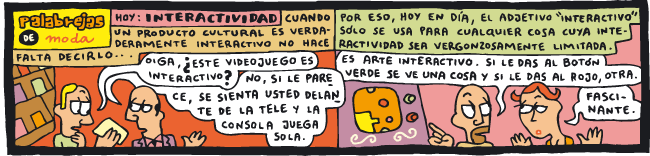
Language does not describe reality, it builds it, so when we use labels as ‘immersive’ or ‘interactive’ we are not describing a fact, we are making a subjective statement. As an example, I will quote some words of a text about Francisco López that I read a couple of years ago:
The invisible ruler in the very centre, immersed in his very own world, deaf to everything that happens outside. He is surrounded by the obedient followers, dedicated and trustful. But in Lopez vision these citizens are about to be executed, blindfolded in their last moments of life. The hangman wears a black hood. Expressing a sinister and utmost pessimistic view, Lopez series of immersive concerts are an outcry for humanity at its darkest and most lonely moment.
Rinus van Alebeek – Das Kleine Field Recordings Festival

If you have never been to a concert by Francisco López, I should explain that the writer is talking about the audience, who usually is asked to sit in the centre of the room with the eyes covered —the idea is to experiment sound without any distraction. Obviously, you are free to do that or not, so I do not think that the main concept is related with anything sinister or pessimistic. We should not confuse the freedom of movement of the body with the freedom of movement of the mind. As Lev Manovic states:
(…) there is the danger that we will interpret “interaction” literally, equating it with physical interaction between a user and a media object (pressing a button, choosing a link, moving the body), at the expense of psychological interaction.
The Language of New Media, Lev Manovich.
Nowadays, when we talk about interaction —related to a work of art, a technological gadget, a game, an installation or any other kind of media— we are talking exclusively about physical interaction, and that is a great danger because, quoting Manovich again:
Before we would look at an image and mentally follow our own private associations to other images. Now interactive computer media asks us instead to click on an image in order to go to another image. Before, we would read a sentence of a story or a line of a poem and think of other lines, images, memories. Now interactive media asks us to click on a highlighted sentence to go to another sentence. In short, we are asked to follow pre-programmed, objectively existing associations. Put differently, in what can be read as an updated version of French philosopher Louis Althusser concept of “interpellation”, we are asked to mistake the structure of somebody’s else mind for our own.
The Language of New Media, Lev Manovich.
The fact is that immersion is always interactive, sometimes just in a psychological sense and sometimes too in a physical sense, but interaction is not immersive just per se. When I talk about immersion, I am talking about something that goes beyond our physical body. Maybe some people have unpleasant reactions to some immersive works, but I think that it is part of the game. When your mind is pulled off its comfort zone, everything is possible: good vibes, bad feelings… Last month I went to a Marcus Schmickler concert, and it was like being in the middle of a tremendous bombing, one of my friends even described it as a visit to hell, but it was an awesome experience.
Personally, I have had some unsettling experiences at several immersive concerts and installations —like at Intersection, by Don Ritter (in the video)— but my motto is: relax, enjoy and let’s see where this will take us. Of course, if you think that the experience is extremely irritating there are no obligations, nobody forces you to endure anything.
I must underline that I do not have anything against interactive art, there are interesting pieces that go far beyond the most widespread and restricted sense of the term. My point is that we should not confuse interaction with the simple act of pushing buttons; and that we can have really immersive, interactive, profound and liberating experiences even without lifting a finger.

El lenguaje no describe la realidad, la construye, así que cuando utilizamos etiquetas como ‘inmersivo’ o ‘interactivo’ no estamos constatando un hecho, estamos haciendo una apreciación subjetiva. Como ejemplo, voy a citar un fragmento de un texto sobre Francisco López que leí hace un par de años:
El soberano invisible se coloca justo en el centro, inmerso en su propio mundo, sordo a todo lo que pasa en el exterior. Está rodeado de seguidores sumisos, entregados y confiados. En la visión de López, los ciudadanos están con los ojos vendados disfrutando de los últimos minutos de su vida, esperando a ser ejecutados. El verdugo lleva una capucha negra. Los conciertos inmersivos de López transmiten una visión siniestra y sumamente pesimista, representan a la humanidad en su momento más oscuro y solitario.
Rinus van Alebeek – Das Kleine Field Recordings Festival
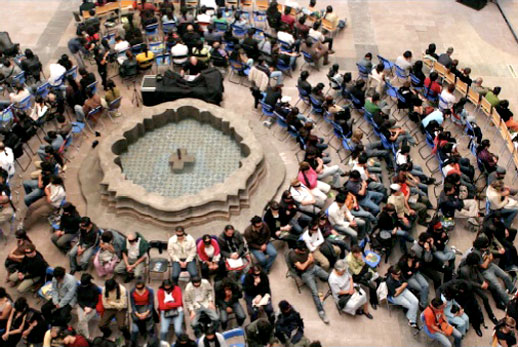
Si nunca habéis estado en un concierto de Francisco López, debería explicar que el autor del texto está hablando del público, al que normalmente se pide que se siente en el centro de la sala con los ojos vendados —la idea es experimentar el sonido sin ninguna distracción externa. Obviamente, cada cual es libre de hacerlo o no, así que no creo que el concepto principal tenga mucho que ver con nada siniestro o pesimista. Deberíamos intentar no confundir la libertad de movimiento del cuerpo con la libertad de movimiento de la mente. Como dice Lev Manovich:
(…) corremos el peligro de interpretar la «interacción» de manera literal, haciéndola equivaler a la interacción física que se da entre un usuario y un objeto mediático (pulsando un botón, escogiendo un enlace o moviendo el cuerpo), a expensas de la interacción psicológica.
El lenguaje de los nuevos medios de comunicación, Lev Manovich.
Actualmente, cuando hablamos de interacción —en relación a una pieza artística, un dispositivo tecnológico, un juego, una instalación o cualquier otra cosa— nos referimos exclusivamente a una interacción física, y ese es un gran peligro porque, citando a Manovich de nuevo:
Antes, podíamos mirar una imagen y seguir mentalmente nuestras propias asociaciones privadas con otras imágenes. Ahora, en cambio, los medios informáticos interactivos nos piden que hagamos clic en una frase subrayada para ir a otra frase. En resumen, se nos pide que sigamos unas asociaciones programadas de antemano y de existencia objetiva. Dicho con otras palabras: en lo que puede interpretarse como una versión actualizada del concepto del filósofo francés Louis Althusser de «interpelación», se nos pide que confundamos la estructura de la mente de otra persona con la nuestra.
El lenguaje de los nuevos medios de comunicación, Lev Manovich.
El hecho es que la inmersión es siempre interactiva, a veces simplemente en sentido psicológico y a veces también en sentido físico, pero la interacción, por sí misma, no es inmersiva. Cuando hablo de inmersión, estoy hablando de algo que va mucho más allá de nuestro cuerpo físico. Es probable que alguna gente sufra reacciones desagradables frente a ciertas piezas inmersivas, pero creo que forma parte del juego. Cuando nuestra mente va más allá de lo que conocemos, todo es posible, buenas y malas sensaciones. El mes pasado fui a un concierto de Marcus Schmickler, y fue como estar en medio de un bombardeo tremebundo, un amigo incluso lo describió como un viaje al infierno, pero fue una experiencia fantástica.
Personalmente, he tenido experiencias inquietantes en más de un concierto e instalación inmersivos —como en Intersection, de Don Ritter (en el vídeo)— pero intento pensar: relájate, disfruta y ya veremos a dónde nos lleva esto. Por supuesto, si la experiencia te resulta realmente molesta, eres libre de irte, nadie te obliga a aguantar nada.
Para acabar, me gustaría subrayar que no tengo nada en contra del arte interactivo, hay piezas muy interesantes que van mucho más allá del sentido más extendido y limitado del término. Lo que intento decir es que no debemos confundir la interacción con el simple hecho de apretar botones; y que podemos tener experiencias realmente inmersivas, interactivas, profundas y liberadoras incluso sin mover ni un dedo.

jose luis espejo wrote:
gran comienzo esa viñeta!
me ha gustado el texto
Posted on 24-Feb-11 at 10:55 am | Permalink
SXP2011: Immersion versus Interaction « Mariam Caballero wrote:
[...] English version http://www.mediateletipos.net/archives/14603 [...]
Posted on 06-Mar-11 at 1:30 pm | Permalink