regenerative music

http://www.eyetap.org/about_us/people/fungja/regen.html

Regenerative Music explores new physiological interfaces for musical instruments. The overall goals of this project are to investigate the creation of “Regenerative Music”. In Regenerative Music, the computer, instead of taking active only cues from the musician, reads physiological signals (heart beat, respiration, brain waves, etc..) from the musician/performer.

These signals are then used to alter the behaviour of the instrument itself. For instance filter settings on the sound can be applied, to which the musician responds by changing the way they play the instrument. The music will in turn generate an emotional response on the part of the musician/performer, and that this emotional response will be detectable by the computer, which then alters the behaviour of the instrument further in response. […]

DECONcert1

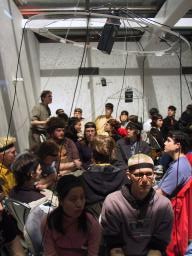
In DECONcert 1, we hooked up 48 people’s EEG signals, which were collectively used to affect the audio environment. Signal averging was used across groups to clean the signal, and look for collective alpha synchronization (which occurs, for instance, when people close their eyes).

DECONcert utilized electroencephalogram (EEG) sensors which sensed electrical activity produced in the brains of the participants. 48 participants were equipped with EEG sensors, and the signals from the brains of the participants were used as signals to alter a computationally controlled soundscape. DECONcert allowed the particpants to form a feedback loop with the computational process of musical composition. The soundscape being generated generates a response from the participants, and the collective response from the group of participants is sensed by the computer, which then alters the music based upon this response. Again, the participants hear the music, and again respond, and again the computer senses and further alters the sound. In this way, collaborative biofeedback is being used in conjuction with an intelligent signal processing system to continually re–generate the music on the fly.

s044r.jpg

Brain-computer interface for music

http://cmr.soc.plymouth.ac.uk/interaction.htm

Brain-computer interface for music

The Future Music Lab at the University of Plymouth, England, is looking for new modes of interaction with musical systems through bio-signal interfacing, networks and responsive environments.

One of the projects the team is working on is a “brain cap” that can detect and recognize musical ideas in the minds of composers with up to 99 percent accuracy. Project leader Eduardo Reck Miranda reported up to 99 percent accuracy in recognizing specific electroencephalogram patterns for musical ideas using a 128-electrode EEG brain cap with signal-processing algorithms. […]

Although the musical ideas tested were extremely simplistic, compared with the complexity of musical composition, the team has demonstrated that the idea of interfacing the brain with computers for musical applications is no longer a science fiction fantasy.

Miranda also plans to switch from the 128-electrode brain cap (rather cumbersome and inelegant) to a magnetic encephalogram, which records the magnetic field generated by neural activity. MEGs are less well-developed than EEGs, but they should provide more accurate, localized signals that might not even require a cap.

Fuente : we-make-money-not-art

Visual Music. Moca.org

http://www.moca.org/museum/exhibitiondetail.php?id=350

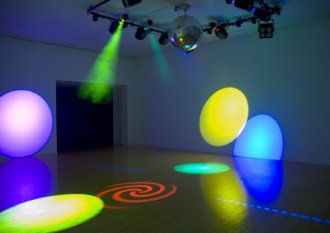
Visual Music surveys the rich and resonant relationship between abstraction, color, and sound over the past century. Follow its fascinating evolution from abstract painting through experimental film, and contemporary installation art in this major exhibition that brings together an international range of works by Wassily Kandinsky, Paul Klee, Oskar Fischinger, Jennifer Steinkamp, and others.
[…+]

Fuente: J_G

visual_music.jpg

The Pro DAW Directory. Audio-txts

http://prodaw.com/prodaw/

Audio Related Articles & Resources On The Web

Fuente: http://createdigitalmusic.com/index.php?option=com_content&task=view&id=334

audio_txts.gif

¿sigues libre?

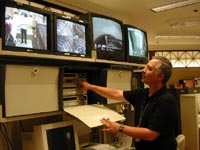
El 29 de junio de 2001, el departamento de policía de Tampa Bay (EEUU) instaló un sistema de vigilancia de 36 cámaras de reconocimiento facial en el distrito de Ybor. Este sistema escanea las caras de la gente que pasea por la zona y las compara con una base de datos de sospechosos criminales.

Más claro en esta animación

video-th.jpg

Convocatoria OFF del LEM

CONVOCATORIA ABIERTA PARA PARTICIPAR EN LA SECCIÓN OFF

Este año, la sección OFF del Festival LEM cambia substancialmente debido al acuerdo establecido entre Gràcia Territori Sonor, la Sociedad General de Autores y Editores (SGAE) y la Xarxa de Músiques de Joventuts Musicals de Catalunya. El objetivo es ampliar el número de residencias y también la dotación de las mismas. A continuación, os explicamos las bases para participar en la convocatoria:

1. Esta convocatoria se dirige a músicos y grupos que quieran dar a conocer su trabajo en el campo de la experimentación sonora, que estén en proceso de profesionalización, que no hayan publicado discos hasta la fecha de esta convocatoria y que residan en el estado español.

2. Los criterios de selección de los proyectos se atienen a la originalidad y a la innovación artística, así como a la adaptabilidad de los mismos para ser presentados en público con un equipo de audio estándar.

3. De todos los proyectos presentados se escogerá uno para cada uno de los tres ámbitos en que se divide la convocatoria. Cada uno de ellos obtendrá una residencia.

4. Ámbitos de la convocatoria:
a) finalización: se dará apoyo a un proyecto sonoro que precise ser concluido en estudio mediante postmasterización, postproducción, etc.
b) formación: se dará apoyo a un proyecto sonoro cuyo creador precise completar elementos de formación técnica relacionados con el proyecto.
c) difusión: se dará apoyo a un proyecto sonoro que se encuentre en la situación de necesitar actuaciones en directo para darlo a conocer.

La fecha límite para enviar los proyectos que quieran optar a esta convocatoria es el día 30 de abril de 2005

Seguir leyendo

bando-offlem05-call-pageint.gif

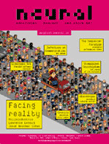
neural.it / nueva versión en papel

Posiblemente la mejor de las revistas de cultura digital está en Italia. Y ahora ha vuelto a sacar un número en papel, en inglés, para llegar más lejos. Supongo.

http://www.neural.it/n/n22e.htm

[Neural n.22 contents]
. . . . . . . . . . . . . . . . . . . . . . . . .
NEURAL http://english.neural.it/
. . . . . . . . . . . . . . . . . . . . . . . . .


/new.media.art/
. Ubermorgen (interview),
. Jonah Brucker Cohen (interview),
. Infection as Communication,
. Videogame Art,
. news (Wimp, mirrorSpace, Fenlandia,
Panos, txtkit).
. reviews (Media Art Net, Future Cinema,
The Cinema Effect, Frags, net.art generator,
Understanding Media Theory, First Person,
Windows and MIrrors)
. . . . . . . . . . . . . . . . . . . . . . . . .
/e.music/
. Staalplaat Soundsystem (interview),
. Cronica (interview),
. The Sequencer Paradigm,
. news: (Shadowplay Reanimated, Spinalcat,
Sonic Fabric, Let Them Sing For You,
Tectonic Plates)
. reviews: (P. Glass S. Reich, DJ Spooky,
Delaware, Bianco-Valente, D.Cope, Pure Dekam,
Dextro - A/Turux-B)
. reviews cd: (Duran Duran Duran,
The Loop Orchestra, Kinetix, Richard H Kirk,
My Robot Friend, Rennie Pilgrem, Radboud Mens,
A Guy Called Gerald, Venetian Snares…)
. . . . . . . . . . . . . . . . . . . . . . . . .
/hacktivism/
. Molleindustria interview,
. Lawrence Lessig interview
. news (You Whores, Vigilance 1.0
Keyboard Acoustic Emanations, Pizza Party,
Empire North).
. reviews: (Broken Channel; Tester,
P2P fightsharing, Biomedia, Spam Kings,
Protocol, Media Politics and the Network Society,
Profiling Machines)

n22.gif

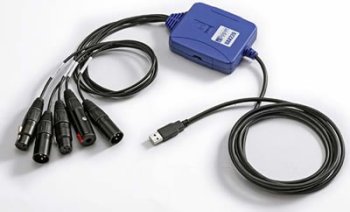
Digigram. USB Audio Interface

http://news.harmony-central.com/Newp/2005/UAX220.html

LITERAL:
Digigram will introduce at NAB 2005 the a professional USB Audio interface that has been specifically designed for broadcast and other pro audio applications. The UAX220, which is barely bigger than a breakout cable and is supplied in a flat 17×22 cm (6 2/3″ x 8 2/3″) bag, combines Digigram’s audio performance with the ease of use of standard USB Audio.

“This product has been designed with the needs of broadcast journalists and other travelling audio professionals in mind. It’s a true plug-and-play device, making a single UAX220 the ideal solution for a user with multiple computers, for example a laptop computer on the road and a desktop computer in the newsroom or studio.” states Marc Benard, Digigram product manager for PC audio interfaces.

Some of the key features:
-2/2 balanced analog I/Os on Neutrik XLR connectors
-24-bit/48 kHz
-Premium dynamic range: >103 dB (A-weighted)
-1/4 inch (6,35 mm) Neutrik headphone output
-Dedicated headphone output stage for low impedance headphones
-Zero-latency direct monitoring
[..+]

interface_midi3.jpg

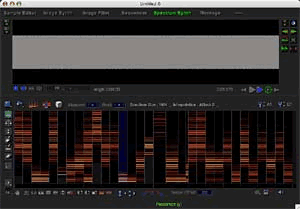
Version 4 of MetaSynth and MetaSynth Pro Announced

http://news.harmony-central.com/Newp/2005/MetaSynth-4.html

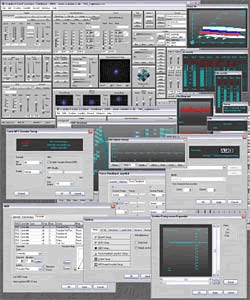
With version 4 of MetaSynth, Eric Wenger’s electronic music and sound design laboratory for the Macintosh has been re-written for OS X and its capabilities have been vastly expanded. MetaSynth 4 has a new sleek user-interface and introduces new realtime capabilities, 16-track integrated mixing room, full-fidelity stereo realtime previews, capture-to-disk, multi-oscillator and FM synthesizers, new granular synthesizer, stereo Image Filter, spectral granular synthesis and much much more. MetaSynth now supports sample rates up to 96 kHz. MetaSynth 4 is a 16-bit application while MetaSynth 4 Pro creates 24-bit audio. The new detailed tutorials provide guidance that will help novices and experts master MetaSynth’s unique approach to music and sound creation. So much has changed that the software jumped directly to version 4 from version 2.7.
[…+]

metasynth.gif

desacuerdos seminario RED

Redes: Modos de acción y producción en la sociedad global

Dirigido por Jesús Carrillo. 12, 13, 19 y 20 de abril de 2005. De 19 a 21h. En el MACBA

El curso aborda un análisis de la cultura contemporánea a partir de la constatación de la expansión de un nuevo paradigma –la red– que se ha impuesto en la organización de los procesos económicos, políticos y de relación social, y que se deriva de la intensificación de los flujos comunicacionales durante el último tercio del siglo XX. El curso define y somete a debate algunos conceptos fundamentales de la sociología y la teoría de la cultura contemporánea, a la luz del análisis de fenómenos y comportamientos específicos que pueden relacionarse con el nuevo modelo red, desde la construcción de la subjetividad al nuevo orden mundial.

video.jpg

www.desacuerdos.org

Theresa Hak Kyung Cha

http://www.fundaciotapies.org/

El sueño del público: Theresa Hak Kyung Cha
hasta 10/04/2005
Fundació Antoni Tàpies
BARCELONA (España)

“El común denominador de mi interés por la literatura, la lingüística y la semiología cinematográfica es el lenguaje. Además, constituye la base fundamental de mi trabajo, tanto por lo referido a las fuentes como a las influencias. Siendo extranjera, en el aprendizaje de nuevas lenguas he ido siempre mucho más allá de la función de éstas como simples medios de comunicación, como sucede por ejemplo con la lengua materna. Para mí, ese aprendizaje ha significado un desacoplamiento consciente que me ha permitido el análisis y la experimentación con otros aspectos lingüísticos.” Theresa Hak Kyung Cha, a propósito de Pause Still (1979)

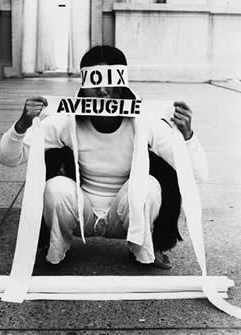
La Fundació Antoni Tàpies presenta por primera vez en España una exposición retrospectiva del trabajo poético y conceptual de la artista coreoamericana Theresa Hak Kyung Cha (Pusa, Corea, 1951 - Nueva York, 1982). La obra de esta artista incluye performances, películas y vídeos, mail art y libros de artista. El trabajo de Cha es una exploración continua sobre temas extraídos de sus experiencias personales como exiliada y de su desplazamiento cultural y lingüístico.

theresahakkyungcha.jpg

suramérica electrónica

http://www.suramericaelectronica.org/

s u r a m e r i c a e l e c t r o n i c a

._ Sudamérica electrónica es una muestra en linea de música digital, a trasmitirse desde siete paises de Latinoamérica, creando una red de comunicación instantanea: un espacio virtual para la interacción y el intercambio.
._ Durante el mes de abril del 2005, 21 exponentes representativos de cada región presentaran su trabajo. Las transmisiones serán en tiempo real y con una fecha dedicada a cada ciudad.
._ Las nuevas posibilidades de compartir información nos permitirán eliminar las restricciones físicas del espacio y conectar las propuestas de cada país con diferentes públicos en el continente y el mundo.
._ La participación de los proyectos de audio, incluye la presencia de muestras de los músicos de estos siete países, formando un primer catalogo de audio digital de nuestro continente.

surv1.jpg

Version 3.50 of crusherX-Live! for Windows Released

http://news.harmony-central.com/Newp/2005/crusherX-Live-350.html

LITERAL:
buero has released a new update to crusherX-Live!, a stand alone and VST multichannel granular soft morphing synthesizer with ASIO, VST, MIDI and Force-Feedback support. Based on traditional granular synthesis, crusher-X can be used as a synthesizer or as a versatile effects unit.
New features/changes in crusherX-Live! 3.50 include:
-Added French interface language, French help files, German help files
-Added color schemes, metal look
-Added full mouse wheel support on all edit boxes and on pm-field
-Added main menu, remove menu buttons
-Added WinXP styles
-Improved behavior of interface elements
-Changed MIDI-learning behavior on 96/97 inc/dec controllers
-Removed strange behavior of cloud phase
-Removed recording bug: in some cases file recording was not finalized

crusher.gif

Taller Arte Interactivo

http://www.dunadigital.com/adee/noticias/index.php?p=265

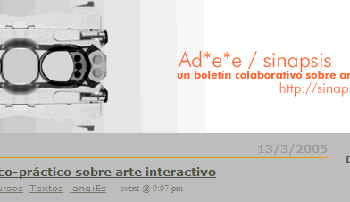
Taller Teórico-práctico sobre arte interactivo
A cargo de Rodrigo Alonso y Mariano Sardón con la participación de especialistas internacionales. Dirigido a artistas, diseñadores, científicos, programadores, arquitectos,
músicos, realizadores audiovisuales y personas interesadas en la producción de arte interactivo.
Abril/Agosto 2005
Convocatoria abierta hasta el 20 de abril
Vacantes limitadas - participación gratuita

Bases e inscripción:
www.espacioft.org.ar/extensioncult/cursos/index.asp

Espacio Fundación Telefónica
Arenales 1540- Capital Federal
Tel/Fax_ (5411) 4333-1300 /4333-1301
espaciofundacion@telefonica.com.ar
www.fundaciontelefonica.com.ar/espacio/

Fuente: Ade*e*/sinapsis

adeesinapsis.gif

carceldeamor.net

www.carceldeamor.net

Cárcel de amor presenta múltiples perspectivas sobre la violencia en la pareja -o en la familia-. Sus límites y la energía que lo anima expresan las relaciones cambiantes y heterogéneas entre el análisis cultural, la crítica política y la producción artística. Programa de cine y vídeo, creación y difusión de un proyecto web -comisariado por Remedios Zafra, conferencias y mesas de debate, la edición de un libro y una acción de Angélica Liddell

No es accidental que el título de este proyecto interdisciplinario -que plantea la posibilidad de representar artística y culturalmente un complejo conjunto de aspectos alrededor del tema de la violencia doméstica/de género- sea Cárcel de amor. Tomado de una novela de amor epistolar y trágico final de Diego de San Pedro (Sevilla, 1492), sus creencias y punto de vista bien pueden, literal y figuradamente, simbolizar en el siglo XXI el temor al sistema patriarcal. Con cinco secciones interconectadas (programa de cine y vídeo, proyecto web, performance, conferencias y una publicación) y concebido como un espacio marcado por la diversidad de opiniones y puntos de vista, Cárcel de amor corre el riesgo, al confrontar un tema tan amplio y brutal, de ser percibido como falto de rigor. Lejos de asumir que “todo vale”, este proyecto, gestado durante un periodo de casi de dos años, se basa en el concepto de que los códigos artísticos y culturales son representaciones colectivas y de que su forma y contenido están conformados por y para el orden social.

Seguir leyendo introducción de Berta Sichel

liisaahtila_4.jpg