Interface MIDI Wi-Fi

http://www.organworks.com

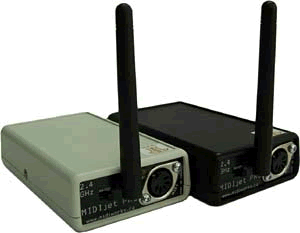
Classic Organ Works has announced the availability of its second wireless MIDI product, MIDIjet Pro.

MIDIjet Pro features an external antenna and a more powerful transmitter than its predecessor, permitting wireless connections up to 500 ft apart. Up to 31 wireless MIDI connections can be made in the same environment.

Using MIDIjet, musicians can connect any two pieces of MIDI gear without cumbersome cables. It is designed to replace standard MIDI cables in situations where cables restrict performer mobility, are visually unpleasant, or awkward to connect.

The MIDIjet Pro Wireless MIDI kit is as easy to use as standard cables - all that’s required is to connect the transmitter to a MIDI Out and receiver to a MIDI In. MIDIjet operates on the 2.4 GHz license-free band and is powered by either 2 ‘AA’ alkaline batteries or a DC adapter.

Fuente: http://news.harmony-central.com/Newp/2005/MIDIjet-Pro.html

interfacemidiwifi.gif

MAF 2005 Festival

http://culturebase.org/home/thailand/MAF05/viewpage.php?menu_item=A_MAF_2005_home

MAF as an ideal stage for cultural exchange
Because of their institutional character, museums often lend an ‘aura’ and ‘artistic status’ to everything they show. By contrast, MAF is adaptive, artistic, free.. MAF show artworks in contemporary social spaces, allowing local public to enjoy the interaction of an artistic happening, thus eliminating the usual distance between visitors and artworks. Our public is constantly in the middle of an event: the exhibition halls are transformed by installations and presentations which, together with artists-meetings, the screenings and the performances, create a total experience. The content of the festival is meant to provoke thought; in its informal format the festival is attractive for art enthusiasts as well as for those interested in communication, IT, cinema, design, and music.

maf2005.jpg

Window Standpoint Series

http://windowstandpoint.free.fr/

Window Standpoint Series

Some artists, all over the globe were asked to share their personal window.
They made a few minutes field recording from their everyday soundscape.
At one geographic point, at one moment,
they catched the sound environment from their window
and made a picture of it.
The main idea is close to one of movement, ubiquity, immobile tourism.

How to share one’s very own identity when confronted to other places?
The window, just as the browser’s window, becomes the access onto
other dimensions (space, time, sound), and proposes as a new platform.
At that very, fixed, moment, the frozen picture becomes one object of sharing.

We hope you will like this journey.
And if you are the owner of a point of view you would like to share,
please do so and contribute.

The project is still running and a developping one.

aMAP-Black.gif

MIDI Sequencing with Hamster Control

http://instruct1.cit.cornell.edu/courses/eceprojectsland/STUDENTPROJ/2002to2003/lil2/

Intelligent MIDI Sequencing with Hamster Control
by Levy Lorenzo

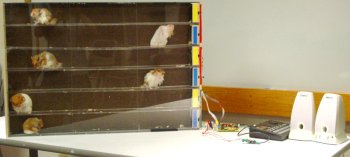
This project was initially fueled by the desire to explore the MIDI protocol. It was decided that this would be accomplished by building a MIDI device. I also aimed to make something novel that had never been done before. But to balance out the unusual nature of its design, I wanted to also to create something that was very musical.After much consideration of different technical design aspects and contemplating various musical ideas, I was able to arrive at a project that would fulfill all of my musical and engineering goals.An intelligent MIDI sequencer was designed with hamster control. The MIDI sequencer intelligently produced melodies by manipulating the musical elements of rhythm and note-choice. Guided by inputs based on hamster movements, Markov chains were used to perform such beat and note computations. In culmination, 3 simultaneous voices were produced spanning 3 octaves and 3 rhythmic tiers. Each voice was controlled by two hamsters: one that was responsible for adjusting the rhythmic qualities of the melody and another that modified the note sequence. With all of these elements in combination, an output was produced with very musical qualities.All of this was implemented using an Atmel Mega32 microcontroller, distance sensors, a HamsterMIDI Controller, and 6 hamsters. Embedded C programming implemented the algorithms and computations within the sequencer.Overall, this project was successful. The control between the hamsters and the musical intelligence turned out very well. The music sounds as good as I imagined, and I am very satisfied with the outcome of my design experience.

( ( o ) )

Fuente : music thing

hamsterMIDI_all.JPG

olia lialina :::: web vernacula

En cierto modo, hace un año, Olia ya anticipó este trabajo con su conferencia en el taller de de narrative media organizado en el contexto de UNIA arteypensamiento.

http://art.teleportacia.org/observation/vernacular/

Olia Lialina says:
When I started to work on the World Wide Web I made a few nice things that were special, different and fresh. They were very different from what was on the web in the mid 90’s. I’ll start with a statement like this, not to show off my contribution, but in order to stress that — although I consider myself to be an early adopter — I came late enough to enjoy and prosper from the “benefits of civilization”. There was a pre-existing environment; a structural, visual and acoustic culture you could play around with, a culture you could break. There was a world of options and one of the options was to be different. So what was this culture? What do we mean by the web of the mid 90’s and when did it end?

Seguir Leyendo…

comunidades electrónicas

Por segundo año consecutivo se viene desarrollando el Premio Digital Communities de Ars Electronica. Vale la pena que revisen este premio que esta orientado a la temática de tecnologia y creacion de comunidades. Ademas el ‘premio’ es mas un ‘grant’, es decir, sirve para proseguir el proyecto. El año pasado un proyecto peruano vinculado a la generacion de cabinas de Internet saco una mencion honorosa, con esto tambien vale decir que no necesariamente se premia comunidades virtuales, sino la generacion de espacios vinculados tecnologia para el desarrollo de un grupo. No dudo que
muchos proyectos mas en America Latina pueda ser seleccionados.

Puedes hacer su nombramiento online en
http://www.aec.at/es/prix/registration/index.asp

ars_electronica_top_logo.gif

Vademecwm Club

VENRES 25 FEBREIRO. ÁS 23:00 HORAS
MINIT (Australia - Staubgold) +
PLUMB & PLUMBER + ISAAC CORDAL (visuales)
DJ SESION STAUBGOLD( Alemania )

SÁBADO 26 FEBREIRO. ÁS 00:00 HORAS
Este viernes 25 de Febrero tenemos una de esas sesiones que titulamos “de lujo”. Llega a Vademecum un sello que en la electrónica contemporánea ha marcado un antes y un después. Riesgo y complejidad como dogmas de fe. Un sello que no necesita mayor presentación y que cuenta entre sus filas con Oren Ambarchi, Ekkehard Ehlers, Vladislav Delay, Faust y un largo catálogo de artistas geniales entre los cuales están nuestros invitados: Minit.
Staubgold ha estado representado en los últimos años con “showcases” monográficos en algunos de los festivales más importantes del mundo. Algunos de los más recientes Sónar y Benicassim 2004.
Además del directo de Minit y la sesión del jefe de Staubgold, Dj Tim, tendremos para la ocasión como invitado local a una joven figura emergente conocido como Plumb & Plumber, acompañado a las visuales por Isaac Cordal.

_MINIT (Australia - Staubgold)
Desde temas reconstruidos hasta piezas electro-acústicas expandidas, Minit exploran y extienden los limites sonoros y musicales de la instrumentación acústica, produciendo ambientes hipnóticos que modelan de forma sutil y alucinante.

Desde entonaciones harmónicas y melódicas frágiles hasta drones lisérgicos, ritmos erráticos fragmentados y disturbios electrónicos, Minit dibujan el momento psicodélico con estados de audición próximos al Trance .

Minit son Jasmine Guffond y Torben Tilly. Se formaron en Sydney en 1997. Usan tecnologías electrónicas, digitales y samplers para manipular sonido grabado que después aborda y manipula las tradiciones convencionales.

Discografia selecionada:

“music” CD (Sigma Editions, 1999)
“bootleg/four” 7″ (Tonschacht, 1999)
“cc/bb” LP (Sigma Editions, 2000)
“now right here” CD/LP (Staubgold, 2004)

minit.jpg
Minit Set

plumberf.jpg
Plum&Plumber

SINSALradio. Program n65. Stephen Orsay.

http://www.sinsalradio.com
ESCOITAR/LISTEN

data.date 25.feb.2005
Stephen Orsak_feb05
[+info]

hello there. I spent way too much time on these pieces between love lost and found. certainly sounds of solitude, a bit awkward to dance to though some have tried. these songs were composed using pro-tools and logic-audio, various hardware and software samplers, and recordings of live performance. I currently live and work in austin, texas.

‘A truely inspiring, organic tale of how you do it right. From the very start I was impressed with the detail and care that has obviously been taken and I would advise anyone even those not usually into anything electronic to check this out’ - Radio909
>>>>>>>>
>>>>>
>>>
>>
>

sinsalradio_65.jpg

Alvin Lucier en Portugal y España

ALVIN LUCIER

PORTUGAL
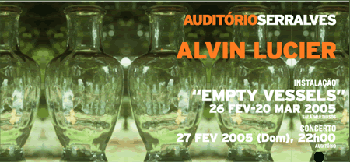
ALVIN LUCIER concerto 27 FEV (Dom), 22h00

Alvin Lucier encontra-se entre os mais distinguidos dos compositores pós-Cageanos. Foi membro fundador da Sonic Arts Union, juntamente com Robert Ashley, David Behrman, e Gordon Mumma, e colaborou frequentemente com ensembles de dança tais como as companhias de Merce Cunningham e de Viola Farber. [ mais informação ]

ESPAÑA
AUDITORIO NACIONAL ( sala de cámara )
Fecha: 5 de marzo de 2005, a las 22:30 h.
Alvin Lucier en Madrid.

alvin_lucier.gif

zemos98_7 em Portugal

http://www.zedosbois.org/indexzdb.htm

Festival zemos98_7 apresenta-se em Portugal
Dia 25 de Fevereiro, na Galeria Zé dos Bois, apresentação da sétima edição do festival audiovisual zemos98, a acontecer em Sevilha de 1 a 6 de Março de 2005.

Na apresentação dar-se-á a conhecer o programa de actividades de Zemos98_7 e será projectado um DVD com as melhores obras que participaram na sexta edição do festival.

Zemos98 é um festival bastante peculiar em muitos sentidos, sobretudo no que respeita ao panorama andaluz: é organizado por uma associação cultural sem fins lucrativos que não depende directamente de nenhuma instituição; não há director, a coordenação é feita por um comité que funciona de forma horizontal e cujos membros têm uma média de idade de 23 anos.
É um festival dedicado à cultura audiovisual entendida numa perspectiva muito ampla, centrando-se particularmente na experimentação e reflexão teórica, sendo mais do que um “festival de curtas-metragens”. O programa de actividades não se compõe unicamente de projecções, complementa-se com exposições, actividades musicais, cénicas e de formação (ateliers, ciclos de conferências) … Todas de acesso gratuito.
De trinta e três países inscritos surgem 427 trabalhos na “convocatória de obras de curta duração realizadas em vídeo”, que integrarão a mostra audiovisual do zemos98_7. Destas obras foram seleccionadas 25 que constituirão a selecção oficial da mostra.
O número de países participantes aumentou consideravelmente nesta edição. Na selecção oficial encontram-se autores procedentes de 10 países, o que supõe a confirmação como um dos festivais de audiovisual mais importantes do Sul da Europa, no que respeita a repercussão da sua convocatória.
Estas obras partilham a capacidade dos seus autores para trabalhar no âmbito da cultura audiovisual com ideias renovadoras, tentando fixar sentimentos, histórias e experiências; empregam para isso “formas de contar” que não costumamos ver nos meios audiovisuais que habitualmente nos rodeiam.
Entre estas obras serão escolhidas as que farão parte do DVD zemos98_7 e será atribuído o prémio de melhor curta-metragem ibero-americana, que consiste numa bolsa de alojamento e matrícula para o Mestrado em Comunicação Audiovisual, organizado em cada dois anos pela Universidade Internacional de Andaluzia na sua sede em La Rábida.
Na Faculdade de Comunicação de Sevilha poderá visualizar-se as obras recebidas na convocatória, sempre e quando se ajustem aos pressupostos, num evento conhecido por maratona audiovisual [a-z]. Esta maratona consiste na projecção de todas as obras alfabeticamente ordenadas segundo os títulos e terá lugar durante a semana de 1 a 6 de Março, quando Zemos98 torna a proporcionar um novo espaço/tempo para a reflexão da cultura audiovisual contemporânea.

www.zemos98.org

maumau_zemos02peq.jpg

Artes Escénicas y Nuevas Tecnologías

Conferencia y posterior debate sobre “ARTES ESCÉNICAS Y NUEVAS TECNOLOGÍAS” que impartirá el profesor Luis Thenon, responsable del Laboratorio de Nuevas Tecnologias de la Imágen, el Sonido y la Escena (LANTISS) de la Universidad de Laval, en Quebec, Canadá. Luis Thenon es un destacado investigador de las relaciones entre Artes Escénicas y Nuevas Tecnologías y en su conferencia nos explicará su reflexiones sobre la temática así como su experiencia en investigación y creación al frente de LANTISS, donde investiga la telepresencia, el cuerpo en entornos virtuales, escenografías multimedia, los cuerpos orquestales, las nuevas narrativas, la generación de imágenes y sonido en tiempo real y demás aspectos relacionados con la aplicación de las tecnologías de información y comunicación a las artes escénicas.

Con posterioridad intenvendrá el profesor de la Universidad Politécnica de Cataluña, Artur Serra, director adjunto de i2CAT (Fundación Internet-2 Cataluña), que nos hablará de la significación tecnológica y a su vez cultural de la fusión y experimentación con las TIC. Acto seguido procederemos al debate sobre la intersección propuesta que tendrá como invitados a profesionales, estudiantes y estudiosos, artistas o teóricos del mundo del teatro, de la danza, las artes visuales, el arte digital y demás experimentadores con nuevas tecnologías. El acto ha sido organizado por Fi2CAT, Vilanova-Neápolis,la AEEC de Canadá y UOC-#Artnodes. La presentación correrá a cargo de Inés Garriga, de Fi2CAT, y moderará la sessión Pau Alsina, profesor de la UOC.

DÍA: Martes, 1 de MARZO 2005.
LUGAR: Sala Drassanes-UOC. Av. Drassanes, 3-5 (justo al lado del Centro de Arte Santa Mónica)
BARCELONA HORA: 19 H IDIOMA: Castellano

01.jpg

kinetoh

http://get.me.it/kinetoh/

kinetoh

LITERAL:
Mimesis of the Non-Mimetic
Kinetoh is an Italy-based group that produces generative artworks. These authors, following traditions of European Neo-Constructivism, Neo-Plasticism and Lyric Abstraction, make series of software that produce high-resolution images reminiscent of Modernist forms. Kinetoh dismantles the models of the last avant-garde by creating the simulacrum of such from software programs capable of imitating, nearly perfectly, those materials that belong to classic art, like pencil, charcoal, and watercolor. These images stand as the mimesis of art that is inherently non-mimetic. Or, also, the virtual reconstruction of the end of high Modernity. Instead of targeting a movement well-established and recognizable, like Abstract Expressionism or Conceptualism, Kinetoh’s strategy is to examine the second line and not so well-explored spaces in Modern Art. Just because of this, they maintain subversive potential (finally, Vermeer became famous in late 19th century, after the discovery photography). There’s the possibility that without photography we wouldn’t be able to see importance of Vermeer’s work. Similarly, we anticipate perhaps Kinetoh will open new spaces in art through their technologies. - Manik

Fuente: http://rhizome.org/netartnews/story.rhiz?&timestamp=20050224

The Allegorical Power Series [netaudio]

http://www.antiopic.com/allegorical/

The Allegorical Power Series

Antiopic’s Allegorical Power Series was a series of online MP3 releases issued monthly from June through December 2003. This series was meant to address the possibilities and roles of abstract or experimental music as social and political response; it attempted to provide a forum and space for artists to present new work as protest and as an exploration of the meaning and potential of sound art in the context of and as response to global injustice. The series was completed with the seventh release in December. All sixty audio tracks will remain online and available indefinitely.

///////////////////////////////////////////////////

Free Music, Literally
Dion Workman, July 2003, NYC (.pdf in volume 3)

Experimental music presents a curious model for thinking about political art. Political sloganeering and symbolic gestures must be immediately rejected as they exist in the realms of representation that this art form attempts to bypass. One could say that experimental music inherently presents us with a political challenge in that it continually questions the dominant idea of what music is and, therefore, encourages a reassessment of all cultural/ideological hierarchies. It rejects musical laws and questions the authority from which these laws have been issued and used in the service of. If it can be said to speak at all it necessarily speaks of freedom; of the free play of sounds and an anarchic approach to organization that allows for creative re-organization, association and interpretation in its receivership. Unfortunately the anarchic spirit of experimental music has, for the most part, been limited to its content with only slight, less concentrated experimentation with its social context. The widespread adoption of contextual paradigms developed by corporate managers of “culture” and entertainment industries undercuts the potential politics expressed in the music, and it will only be through a rejection of such ready-made contexts and the conscious creation of new contexts that the political implications of this music will be more fully realized.

Antiopic’s Allegorical Power series presents an obvious place to begin reassessing one aspect of the context in which experimental music exists: the context of commodity status and exchange and its potential negation through technological developments. The positive aspect of this potential lies in the ability of producers/listeners to create forms of distribution that oppose the dominant models of distribution with a radicality comparable to the music’s critique of dominant ideas of musicality. […continue]

///////////////////////////////////////////////////

march22-outline-aps2.jpg

The Color of the sound

http://news.bbc.co.uk/2/hi/technology/4257961.stm

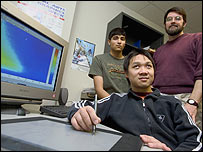
A blind student has developed software that turns colours into musical notes so that he can read weather maps.

Victor Wong, a graduate student from Hong Kong studying at Cornell University in New York State, had to read coloured maps of the upper atmosphere as part of his research.
To study “space weather” Mr Wong needed to explore minute fluctuations in order to create mathematical models.
A number of solutions were tried, including having a colleague describe the maps and attempting to print them in Braille.
Mr Wong eventually hit upon the idea of translating individual colours into music, and enlisted the help of a computer graphics specialist and another student to do the programming work.
‘Three dimensions’
“The images have three dimensions and I had to find a way of reading them myself,” Mr Wong told the BBC News website.

Fuente: http://www.we-make-money-not-art.com/archives/004535.php

colour_sound_bbc.jpg

Janek Schaefer

http://www.audioh.com

Turntablismo
Conociendo más a este artista

janek.gif