Genesis Breyer P-Orridge – Interview

|

Aquí va el video de una entrevista muy completa e interesante a Genesis Breyer P. Orridge que nos hemos cruzado por la red. Fue realizada el pasado año y es util para conocer de primera mano la trayectoria y opiniones de este agitador de gran influencia musical, artística y (contra)cultural. Recientemente nos enteramos de que en octubre (unos meses después de esta entrevista) falleció repentínamente su compañera Lady Breyer P. Orridge, a la que estaba unido desde hace casi quince años, también en su banda Psychic TV/PTV3 y en el innovador proyecto de pandrogenia Breaking Sex que iniciaron hace tiempo.

[VIDEO: GENESIS BREYER P-ORRIDGE: The MetalKult Interview]

MetalKult had the distinct pleasure to interview one of the most influential experimental musicians of the past 30 years, Genesis Breyer P-Orridge.

As a founding member of Seventies avant-garde acts Coum Transmissions and Throbbing Gristle, the English-born Genesis effectively laid the groundwork for what would become industrial music. (Quite literally, as Throbbing Gristle reportedly coined the term when they formed their Industrial Records label.) Make no mistake, without Gen there would be no Nine Inch Nails, Ministry or Marilyn Manson.

In the Eighties, Genesis founded “hyperdelic acid house” group Psychic TV, with whom he went on to explore psychedelic head music and occult spirituality (the roots of which stretch back to Genesis’ childhood and his grandmother who was a medium). Psychic TV’s latest record, Hell Is Invisible…Heaven Is Her/e was released this past June on Sweet Nothing records.

Over the years, Genesis’ creative orbit has crossed the paths of many influential artists, including beat writers William S. Burroughs and Brion Gysin, psychedelic guru Dr. Timothy Leary, industrial supergroup Pigface and Japanese noise band Merzbow.

In our comprehensive seven-part interview, hear Genesis talk about a range of topics, including his early years in Throbbing Gristle, his exile from Britain, his tragic accident at Rick Rubin’s studio and much more

gen-comp.jpg

¿protección de datos?

|

El último barómetro del CIS incluye varias preguntas relacionadas con la privacidad de las personas y la protección de los datos personales y de manera mayoritaria (73,2%) se muestra a favor de la colocación de cámaras de seguridad o videovigilancia por considerar que proporcionan más seguridad, evitan delitos o permiten la detención de los delincuentes.

Sólo un 9,5% de los encuestados se manifiesta en contra de esas cámaras alegando que los ciudadanos pierden intimidad, privacidad o libertad. La mayoría de los españoles (73,2%) se muestra partidaria de que la difusión de las imágenes grabadas por esas cámaras en televisión o Internet esté controlada de alguna manera.

Un poco más de la mitad de los ciudadanos (52,4%) conoce la existencia de la ley que protege la intimidad personal y familiar, aunque el 34% acudiría directamente al Juzgado si quisiera denunciar la utilización de sus datos sin su consentimiento, y sólo un 15,5% lo haría a través del organismo público encargado de tutelar ese derecho.

De hecho, la mayoría (51,4%) desconoce la existencia de la Agencia Española de Protección de Datos. El 58,8% de los encuestados considera muy o bastante fiable el pago en establecimiento con tarjeta de crédito, mientras que el 78,8% cree que esa seguridad es poca o ninguna a la hora de utilizar la tarjeta para comprar por Internet.

El Mundo

A mi se me ocurre decir que el 73,2% de los españoles cree en “el nuevo género de ficción”. Seguimos en www.paneldecontrol.cc

WORK OVERTURE PROJECT in the 38th FESTIVAL SYNTHESE BOURGES 2008

|

WORK OVERTURE PROJECT in the 38th FESTIVAL SYNTHESE BOURGES 2008

“From Revolts to Revolutions”

The theme of the Open Work 2008 is “From Revolts to Revolutions”.

In 1948, in the musical space, the serial field wanted to represent the modernity abolishing the tonal privileges with shots of retrograde canons and mirror writings, being on the whole old rules advantageously presented. This post second war unique model eradicated specific and national cultures. Among the literary sets of the time this model was seen as little preoccupied with communication and split from established order. At the same time, in the re-conquered radiotelephony companies (after World War II), the instruments of communication were to reach the status of instrumentarium for creation. The new electroacoustic world was big-banging, space and time were untied, deferred time, reconstructed spaces, and the ocean of sounds. Where was the revolt, where was the revolution? In 1968, in an environment of wars in series, a new search for freedom rose in numerous countries. Once more while history was being rewritten, broadcasting companies held their part. Freedom of thought, of creation, of expression, of relations connected with new technologies, internationalism and networks, the musical revolution was becoming more and more effective. Today, radios are communication media, but the networks of ideas, of communication and exchange have been amplified and multiplied. History goes on, creation by its side. The 2008 Open work partakes in these networks and proposes to participate on the theme « From revolts to revolutions ». The piece is musical, political, ideological, historical following your choice, and has sounds, texts, quota-sounds, echoes, places, times, countries, reports, and dedications following your mood and choice.

Every year, composers participating in the overture project are more and more numerous. This is the reason why the organizers have decided to set up the following principles:

* All works will be played continuously during the Festival “Synthèse 2008”
* Listeners will communicate their appreciations and preferences
* The organizers will select twenty pieces
* These twenty pieces will be programmed in two concerts of the “Oeuvre Ouverte” series, the first concert at the 38th festival “Synthèse 2008”, the second concert at the 39th festival “Synthèse 2009”.

1. The work overture project is opened to all composers, creators and sonic sculptors who wish to participate.
2. All works have to be finished before mid May 2008. Any work that does not deal with the theme will not be diffused.
3. The duration of your work must span not less than 4 and not more than 6 minutes maximum.
4. Your work must be exempt from all broadcasting and reproduction rights, excepted of course author’s royalties.
5. You must send your work on a CD.
6. Your work will be kept at the IMEB’s and MISAME’s International Sound Library.

To take part in the work overture project you must accept all these conditions.

Dates :

* Please let us know about your decision and send us the information on your work title and duration before the end of March 2008.

The list of participants will be published on the IMEB’s website (www.imeb.net) by mid-April.

* Please send us, by email exclusively, your programme note, biography and photograph before April 30, 2008. These information will be published on the website www.imeb.net / under the headings Festival / Work overture
* Please send us your work between April 30, 2008 the earliest and May 10, 2008 the latest.

For any additional information, please contact:
IMEB Place André Malraux – BP 39 18001 Bourges (France)
Tél. + 33 (0)2 48 20 41 87 Fax + 33 (0)2 48 20 45 51
email: imeb-bourges@orange.frCet e-mail est protégé contre les robots collecteurs de mails, votre navigateur doit accepter le Javascript pour le voir web: http://www.imeb.net

title_back.jpg

Inferno, otra arma sónica para la colección

|

http://blog.wired.com/defense/2008/02/i-was-a-puke-ra.html
http://www.zemos98.org/controlsonoro/

Literal: (de Gizmodo)
Inferno provoca vértigo, nausea y vómitos, no es un cocktail de tequila.

Inferno es una “barrera sónica”, un cacharro que genera cuatro frecuencias entre los 2 y 5 kilohercios y hace que te quedes en el sitio preso del vértigo, la nausea, un dolor en el pecho insoportable y, finalmente, vómitos a tutiplén. Sharon Weinberger, de Wired, lo ha probado y dice que, efectivamente, la combinación de frecuencias es el sonido más desagradable que ha escuchado en su vida. Tanto que es cierto que te hace sentir fatal sin llegar a ser más ruidoso que una alarma típica (120 decibelios). Es decir: que es el equivalente de irse de copas, pero sin la diversión. — Jesús Díaz [Danger Room]

sonic.jpg

Free Music Software . org

|


A collection of the best Free Music Software floating around in Cyberspace.

http://freemusicsoftware.org/

On this site you will find a carefully selected collection of the Internet’s best freeware VST Instruments, samples and soundfonts, sequencers, effects processors, dj tools, CD burners, rippers & more…. It’s a growing list, so please feel free to make a suggestion.

free_music_software.png

13º Encuentro AVLAB

|

susana_avlab.jpg

www.medialab-prado.es

13º Encuentro AVLAB

http://medialab-prado.es/article/12_encuentro_avlab

Coordinador: Daniel González Xavier

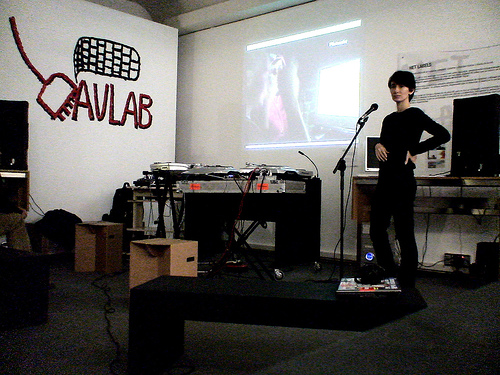
Los encuentros surgen con la idea de ofrecer un lugar físico donde poder compartir conocimientos, críticas y opiniones acerca del proceso creativo en los ámbitos de la música experimental, electrónica, electroacústica, el arte sonoro, los dispositivos interactivos y en general el procesado de audio y vídeo en directo.

Los proyectos presentados en AVLAB tienen en común su afán experimental, aunque tienen orientaciones muy diversas y no siempre utilizan “nuevas tecnologías”.

- TOCCATA y DETRAS/DES TRACES (Raphael Larre, Francesco Filidei y Baba Noriko)

Noriko Baba (compositora, Japon), Raphael Larre (artista visual, Francia) y Francesco Filidei (composito, Italia) son integrantes de la sección artística de la instituición Casa de Velazquez, donde han iniciado una serie de colaboraciones.
En esta ocasión compartirán detalles sobre la elaboracion de sus trabajos personales, y se centrarán en las propuestas Toccata y Detras/Des traces y Fluxus Thing en la que colabora también la artista y performer Martinha Maia.

- Proyecto Hades : Tsunami Killcore y No-Preset

Hades es un proyecto de la compositora, productora musical y artista multidisciplinar Sofia aka Tsunami Killcore en colaboración con el video-artista y VJ valenciano No-Preset.

Procesamiento y proyección de fuentes lumínicas a través de medios tecnológicos, uso de la realimentación y el error digital, sonido noise y producción en tiempo real, son la base para generar el lenguaje estético de este proyecto que evoca paisajes de oscuridad mental.

http://www.errortronika.net
http://www.myspace.com/tsunamikillcore

- Dj Chelis + IdealWord

Enrique Radigales (IdealWord) acompaña con sus imágenes derivadas de de la figuración de su proyectos idealword.org o la abstracción de “microrutinas”:

El genero sonoro que Chelis denomina “Coplastep”, una osada combinación de dubstep y copla presentado por primera vez en la edición 2007 del festival aragonés Periferias. Para el DJ, “en Coplastep se juntan los primeros sonidos de los que tengo conciencia (la copla sonaba en casa de mi abuela cuando era pequeño) con algunos de los últimos sonidos surgidos en la prolífica escena electrónica”.

http://www.myspace.com/djchelis
http://www.idealword.orgwww.idealword.org

Digital Artists Handbook

|

The Digital Artists Handbook is an up to date, reliable and accessible source of information that introduces you to different tools, resources and ways of working related to digital art.

The goal of the Handbook is to be a signpost, a source of practical information and content that bridges the gap between new users and the platforms and resources that are available, but not always very accessible. The Handbook will be slowly filled with articles written by invited artists and specialists, talking about their tools and ways of working. Some articles are introductions to tools, others are descriptions of methodologies, concepts and technologies.

When discussing software, the focus of this Handbook is on Free/Libre Open Source Software. The Handbook aims to give artists information about the available tools but also about the practicalities related to Free Software and Open Content, such as collaborative development and licenses. All this to facilitate exchange between artists, to take away some of the fears when it comes to open content licenses, sharing code, and to give a perspective on various ways of working and collaborating.

* Graphics
* Working with sound
* Working with others
* Publishing your work
* Working with digital video
* Software art
* Developing your own hardware

itheme_logo.jpg

OLPC Sound Sample Archive – Creative Commons Licensed

|

Dr. Richard Boulanger and colleagues have created an 8.5 GB audio library of
samples and sounds which has been licensed under the Creative Commons
license. It is available at: http://wiki.laptop.org/go/Sound_samples
It is aimed primarily at participants of the One Laptop per Child / XO
laptop project but its a great source of public domain audio material as you
can pretty much use them for any purpose once you attribute the source of
the materials.

[Bibliografía] Music: A Mathematical Offering

|

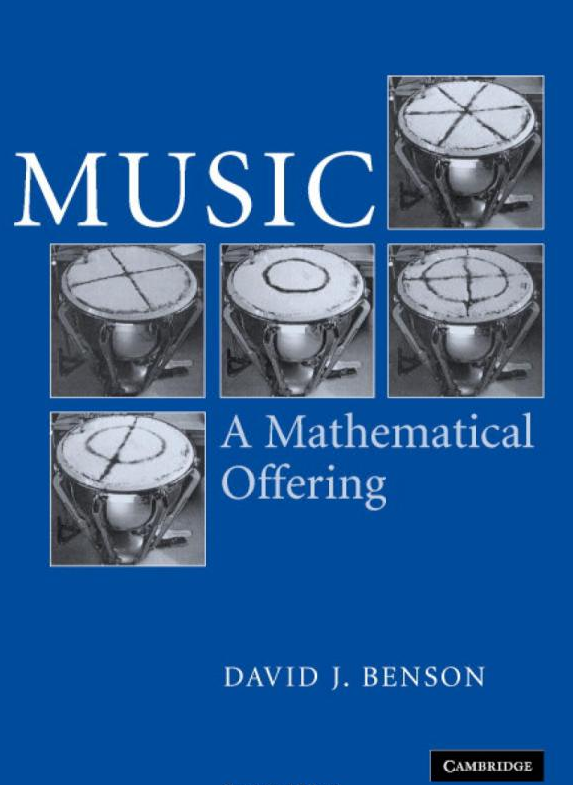
Music: A Mathematical Offering
by Dave Benson
Cambridge University Press; 2006

[+info]

[ONLINE VERSION (.PDF) - Updated Aug 2007]

Since the time of the Ancient Greeks, much has been written about the relation between mathematics and music: from harmony and number theory, to musical patterns and group theory. Benson provides a wealth of information here to enable the teacher, the student, or the interested amateur to understand, at varying levels of technicality, the real interplay between these two ancient disciplines. The story is long as well as broad and involves physics, biology, psycho acoustics, the history of science, and digital technology as well as, of course, mathematics and music. Starting with the structure of the human ear and its relationship with Fourier analysis, the story proceeds via the mathematics of musical instruments to the ideas of consonance and dissonance, and then to scales and temperaments. This is a must-have book if you want to know about the music of the spheres or digital music and many things in between.

> The only modern account that is comprehensive and thorough > Lots of musical examples that make the mathematical ideas concrete; lots of illustrations > Self-contained for the enthusiast but also usable as a course text in mathematics, physics and engineering departments

Contents

Preface; Introduction; Acknowledgements; 1. Waves and harmonics; 2. Fourier theory; 3. A mathematician’s guide to the orchestra; 4. Consonance and dissonance; 5. Scales and temperaments: the fivefold way; 6. More scales and temperaments; 7. Digital music; 8. Synthesis; 9. Symmetry in music; Appendix A. Bessel functions; Appendix B. Equal tempered scales; Appendix C. Frequency and MIDI chart; Appendix D. Intervals; Appendix E. Just, equal and meantone scales compared; Appendix F. Music theory; Appendix G. Recordings; Bibliography; Index.

music_mathematical_offering_cover.png

[Bibliografía] MUSIMATHICS

|

MUSIMATHICS
Volume I: Musical Elements
Volume II: Musical Signals
by Dr. Gareth Loy
MIT Press, 2006 – 2007

http://www.musimathics.com/

“Mathematics can be as effortless as humming a tune, if you know the tune,” writes Gareth Loy. In Musimathics, Loy teaches us the tune, providing a friendly and spirited tour of the mathematics of music–a commonsense, self-contained introduction for the nonspecialist reader. It is designed for musicians who find their art increasingly mediated by technology, and for anyone who is interested in the intersection of art and science.

In this volume, Loy presents the materials of music (notes, intervals, and scales); the physical properties of music (frequency, amplitude, duration, and timbre); the perception of music and sound (how we hear); and music composition. Musimathics is carefully structured so that new topics depend strictly on topics already presented, carrying the reader progressively from basic subjects to more advanced ones. Cross-references point to related topics and an extensive glossary defines commonly used terms. The book explains the mathematics and physics of music for the reader whose mathematics may not have gone beyond the early undergraduate level. Calling himself “a composer seduced into mathematics,” Loy provides answers to foundational questions about the mathematics of music accessibly yet rigorously. The topics are all subjects that contemporary composers, musicians, and musical engineers have found to be important. The examples given are all practical problems in music and audio. The level of scholarship and the pedagogical approach also make Musimathics ideal for classroom use. Additional material can be found at a companion web site.

About the author

Gareth Loy is a musician and award-winning composer. He has published widely and, during a long and successful career at the cutting edge of multimedia computing, has worked as a researcher, lecturer, programmer, software architect, and digital systems engineer. He is President of Gareth, Inc., a provider of software engineering and consulting services internationally.

loy_revised_2.gif